Sewer camera inspection
The first step on any recurring backup here.
Read more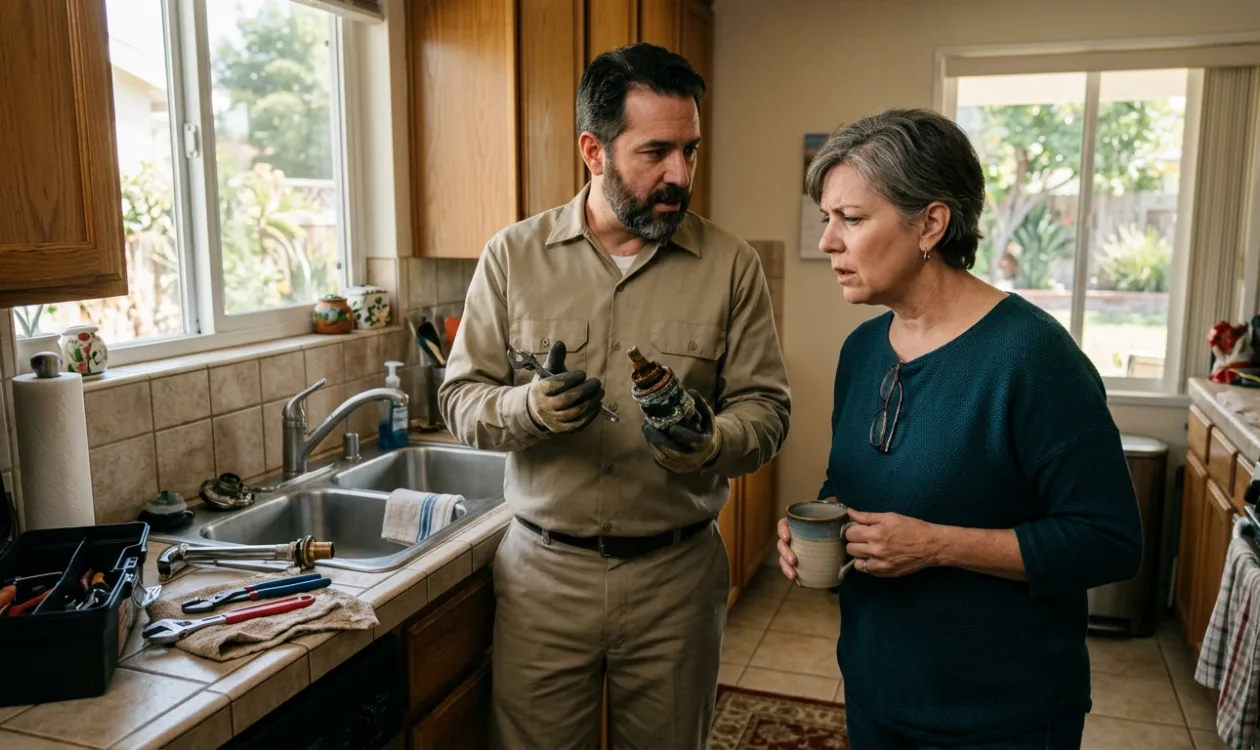
92840 · Chapman Avenue & Lewis Street
The streets around the Christ Cathedral campus are some of the most heavily planted in Garden Grove. Sixty years of tree growth makes them pleasant to walk and hard on sewer laterals, and the houses beneath the canopy are the same slab-era construction as the rest of the city.
Recurring drain backups, a slow toilet that clears then returns, or a sinkhole forming in the parkway.
Get a Cathedral Area Pro OutThe residential streets around the Christ Cathedral campus, running off Chapman Avenue and Lewis Street, were planted generously when they were built and the trees have had six decades to establish. The result is genuine shade and genuine root systems, and the root systems are the plumbing story here.
A tree root does not seek out a sewer pipe. It seeks moisture and nutrients, and a slightly leaking clay joint provides both in concentrated form. The vapor escaping a joint in dry soil is enough to attract growth from a surprising distance. Once a fine root reaches the joint it thickens over successive seasons, prising the joint wider and admitting more root behind it.
Inside the pipe the root forms a mesh across the bore. Paper and solids catch on it, and what began as a slight restriction becomes a full blockage. The characteristic symptom is a drain that works, then slows, then stops, then works perfectly again after cabling, and then repeats the sequence.
Tree density. The same clay pipe and the same joints exist across most of the older parts of Garden Grove, but the frequency of root intrusion tracks the number and size of trees within reach of the lateral. On these streets the canopy is dense and the trunks are large, and the calls reflect it.
The houses themselves are typical of the era. Slab on grade, copper supply, water heater in the garage, and a pressure regulator near the front that has probably outlived its design life. Slab leaks, heater replacements and regulator failures all appear here at the same rate as elsewhere in the city.
One local variation worth mentioning: large trees close to a house can also affect the water service line and, in some soil conditions, contribute to slab movement. Neither is common, but where a house shows both a recurring sewer problem and unexplained cracking, it is worth looking at together rather than as two unrelated issues.
The other practical consequence of mature planting is that nobody wants a trench through it. Front gardens on these streets often represent decades of work, and the cost of restoring one is not trivial. That makes trenchless methods disproportionately attractive here, and they are usually the first option assessed rather than the last.
Quick facts
Look at your parkway between the pavement and the curb. A soft patch, a dip in the lawn or grass that stays greener than everything around it in late summer can all indicate a leaking pipe below feeding the roots above.
Roots find leaks before people do, and the lawn shows it first.
Living with trees
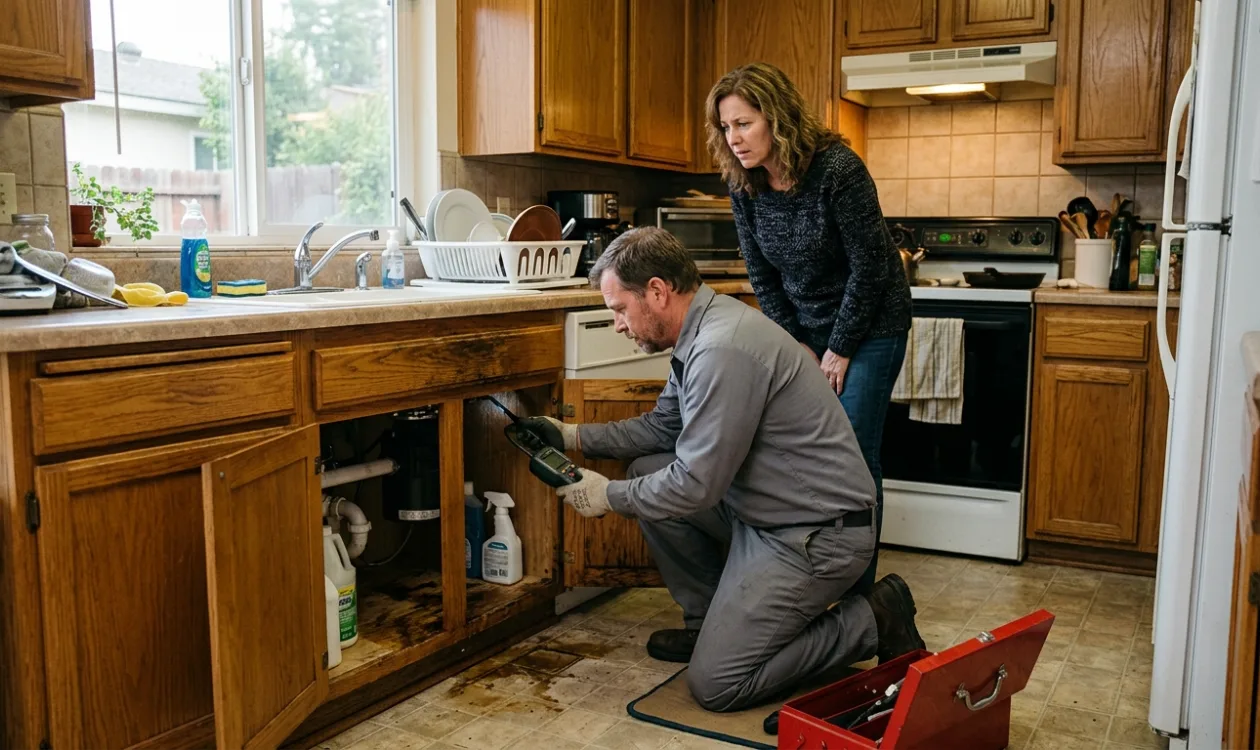
Almost nobody wants to remove a mature tree to solve a plumbing problem, and in most cases they do not have to. Sealing the pipe removes the reason the roots are there.
On a recurring backup the inspection is not optional. It distinguishes roots at intact joints, which can be maintained, from a pipe that has offset or broken, which cannot. It also locates the problem precisely, which is what makes a targeted repair possible instead of a full replacement.
Where the pipe is sound, jetting with the appropriate head cuts the root mass and scours the pipe wall far more completely than a cable. Combined with a realistic re-service interval, this is a legitimate long-term strategy on a pipe that is otherwise in good condition.
Cured-in-place lining is particularly well suited to this area. It seals every joint along the run, which is exactly where the roots enter, and it requires access points rather than a trench. A mature front garden survives the process largely intact, which is frequently the deciding factor for owners here.
Sometimes it cannot. A collapsed section, a lateral that has dropped, or a connection at the main that has failed may require excavation. When it does, the conversation should include how the surface will be restored and who is responsible for the planting, before work starts rather than afterwards.
While a pro is on site for sewer work, it costs nothing to have the water pressure read at a hose bib and the water heater’s age checked off the data plate. Both take two minutes and both are the kind of thing that turns into an emergency call six months later if nobody looks.
Most requested here
The first step on any recurring backup here.
Read moreSealing joints without trenching an established garden.
Read moreRoot cutting and a properly scoured pipe wall.
Read moreOffset joints and broken sections that clearing cannot hold.
Read moreThe usual slab-era copper failures under these houses.
Read moreOriginal-era regulators well past their service life.
Read moreHow a call works
Clear it, see it, then decide once rather than paying for the same clearance every year.
Ask About Lining Without Digging
Mention how many times the line has been cleared before. That history is part of the diagnosis.
Flow restored first so the house is usable, using a cutting head appropriate to a root mass.
The lateral inspected end to end with the footage shown and the fault located and measured from the cleanout.
Maintain on a schedule, spot repair, line the run, or replace. Costs and lifespans for each.
Work completed, re-inspected by camera, and the garden put back where excavation was involved.
Local questions
Whether the tree has to go, what lining actually does, and how often this recurs.
In most cases no. Roots enter through gaps in the pipe, and if the pipe is sealed properly there is no longer a gap to enter through.
Removal is occasionally recommended where a trunk sits directly over the lateral and replacement is unavoidable, but it is a last resort rather than a default.
Cured-in-place liners are generally rated for many decades of service, comparable to a new pipe.
What matters more than the headline figure is installation quality, so ask what is being installed and whether the finished work is camera-verified.
Because something below is providing water and nutrients. A leaking joint feeds the grass and the roots above it.
It is a useful early indicator. A patch that stays green through a dry spell is worth mentioning when you call.
They can exploit an existing leak in a supply line, though it is far less common than in a sewer because supply pipe is pressurized and jointed differently.
A supply leak usually announces itself through the water meter rather than through a blockage.
On a pipe with established root intrusion, intervals of roughly a year to eighteen months are typical, and they shorten over time as the root mass matures.
That trend is the real argument for fixing rather than maintaining indefinitely.
It can be. A broken sewer or water line washes soil into the pipe over time, and the void eventually shows at the surface as a dip or a hole.
It should be looked at promptly, both for the plumbing and for the obvious safety reason.
Standard homeowner policies frequently exclude gradual deterioration of a sewer lateral, though some offer service line endorsements that cover it.
Check your policy specifically. A camera report documenting the cause is what any claim will be built on.
On a house of this age in this area, it is a sensible precaution. A buyer’s inspection finding a failed lateral late in escrow is a much worse negotiating position than knowing in advance.
A camera survey is inexpensive relative to what it can prevent.
Next door
Older housing a short distance east.
The Civic Center blocks alongside.
Same lateral problems, fewer trees.
Commercial frontage to the south.
92840 · under the canopy
You can keep the trees. What has to change is the joint that is letting them in.