Leak detection
The acoustic and pressure work that pins the escape point before excavation.
Read more
Meter to house
A soft wet strip across the parkway, pressure that has quietly dropped, a meter that turns with the house shut off. That is the service line between the meter and your home, and it is entirely yours.
A meter reading with the house off is the single most useful thing to have ready.
Call (657) 354-1942 About Your Service LineThe main water line (the service line) is the single pressurized pipe that carries all the water your house uses from the meter at the street to the point where it enters the building and splits into the internal distribution system. There is one of them, it is under constant pressure, and in most Garden Grove homes it is buried a few feet down beneath the front yard, the parkway and sometimes a driveway.
Responsibility usually divides at the meter: the utility maintains its side, and the line from the meter to the house is the property owner's. That is why a leak here shows up on your bill and not the city's.
Corrosion in galvanized steel. The oldest service lines in the city, largely serving the early-1900s housing near Historic Main Street and the Village Green, are galvanized. They corrode from the inside out, which produces two symptoms at once: a bore progressively restricted by rust, and eventual pinhole failure through the wall. A galvanized service line delivering poor pressure is often not blocked anywhere in particular, the whole pipe has narrowed.
Pinholes in copper. Copper service lines in the postwar tracts fail the same way copper fails elsewhere: thinning from the inside, accelerated by soil chemistry and water velocity, until a needle-fine jet opens. Because the line is buried, that jet saturates soil rather than announcing itself.
Mechanical damage. Root pressure from mature street trees, ground movement, or a shovel or auger during landscaping and fencing work. Impact failures are usually abrupt and dramatic, a genuine gusher rather than a slow seep.
Failed joints and old repairs. A line that has been repaired several times over decades accumulates couplings, and each one is a potential failure point. A service line with four visible repair clamps is telling you something about its remaining life.
The clearest is a wet or unusually green strip in the parkway or front lawn, following a line from the meter toward the house, that stays damp through dry weather. Then: water bills that stepped up and stayed there; whole-house pressure that has gradually declined over months or years; the sound of running water near where the line enters the building; a meter that continues to register with every fixture in the house closed; and in bad cases, soil settlement or a sinkhole developing along the route.
Because the symptoms overlap with slab leaks and irrigation faults, diagnosis starts by isolating: shut the house off at the main and watch the meter. Water still moving means the loss is between the meter and that valve, the service line itself. That single test separates this job from every other leak on the property.
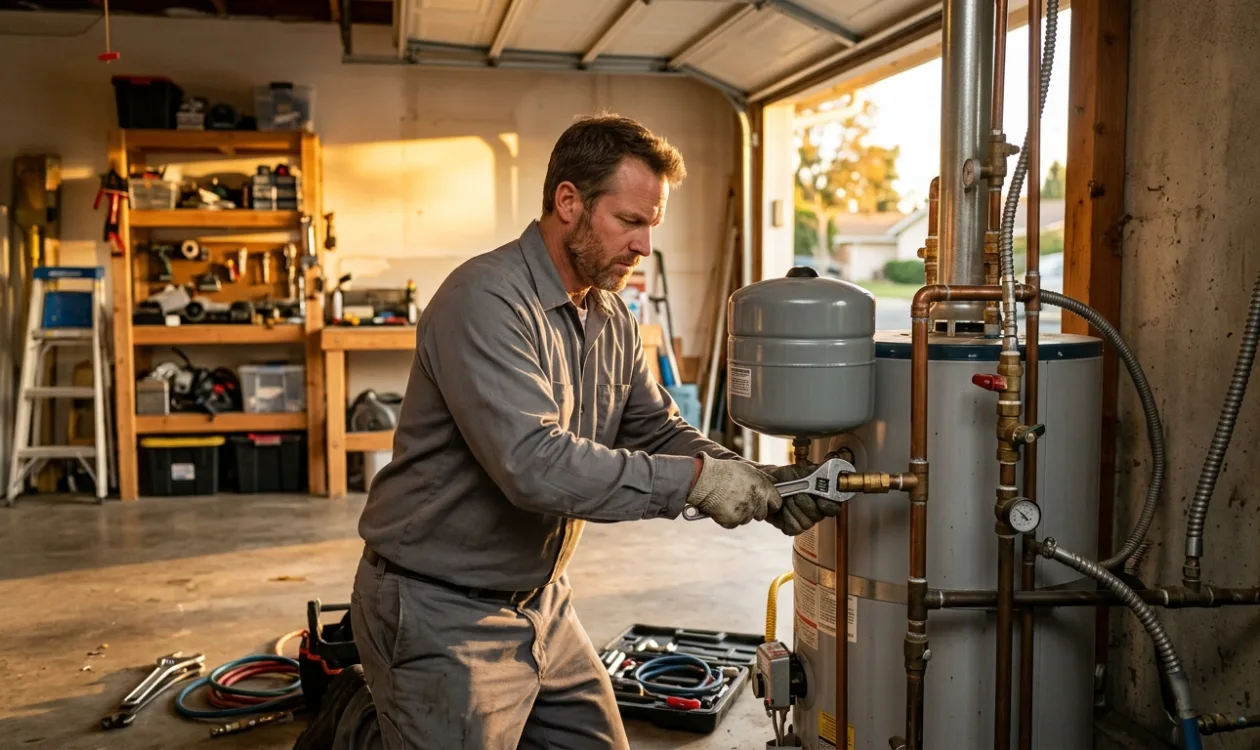
Close the house main valve and watch the meter. If it still turns, the leak is upstream of that valve, in the service line. If it stops, look inside the house.
Sprinkler systems often tee off before the house valve. An irrigation leak imitates a service line leak exactly, and is far cheaper to repair.
A gauge on a hose bib takes seconds. Low static pressure points at a restricted line; high pressure points at a failed regulator instead.
Service line replacement generally requires a City of Garden Grove permit and inspection, and work in the public right of way brings additional requirements.
Locating the run and its depth is what keeps the excavation targeted.
How the work runs
The diagnosis is quick. The decision is repair one point or replace the run.
Have the Service Line CheckedLow pressure can be the line, the regulator or a galvanized bore. Different fixes entirely.
Meter watched with the house valve closed, irrigation ruled out, and static pressure read at a hose bib.
Route and depth traced from the surface, then acoustic listening to pin the escape point before anything is dug.
A single mechanical failure in sound pipe is a spot repair. A corroded or repeatedly patched line is a replacement conversation.
New line pressurized and tested, city inspection completed, then backfill compacted and the surface put back.
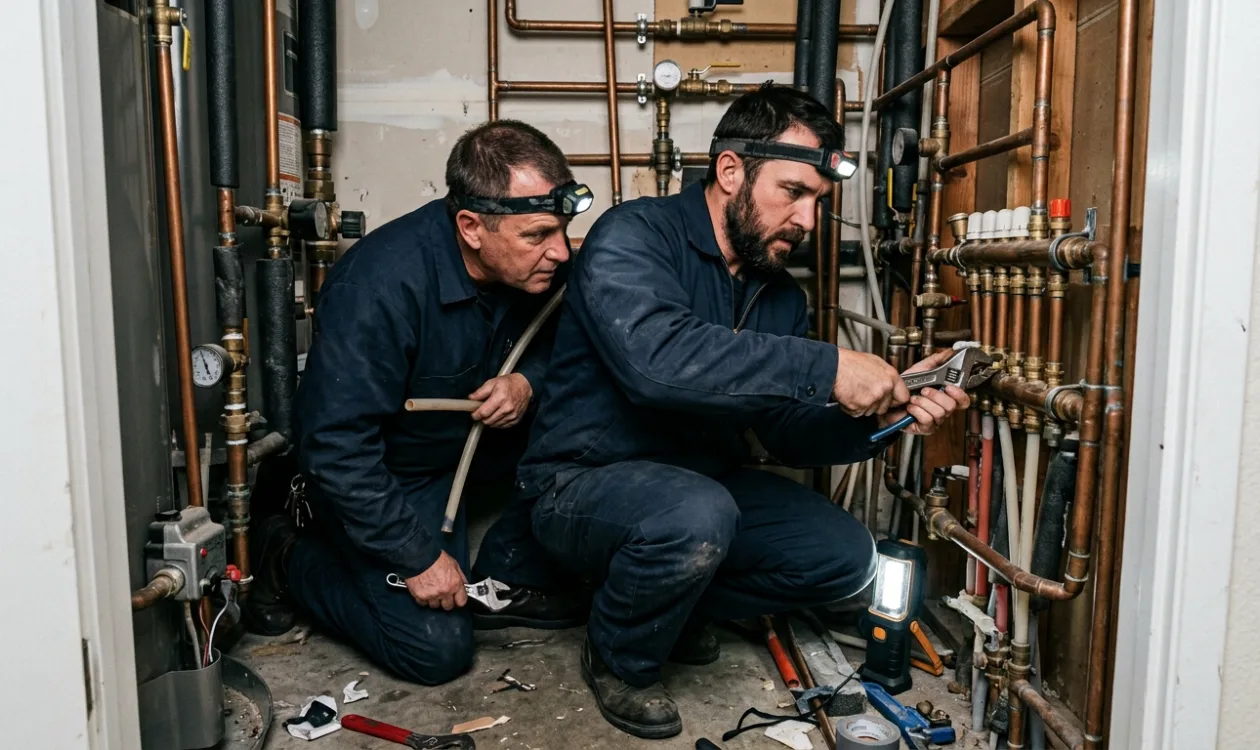
Repair or replace
Spot repair exposes the failure, cuts out the damaged section and replaces it with new pipe and couplings. It is fast, comparatively cheap, and entirely appropriate when the cause was mechanical (a shovel strike, a root crushing one point), and the rest of the line is in good condition.
It is a poor choice on a line failing from age. Galvanized pipe that has corroded through in one place is corroded everywhere, and clamping one pinhole in thinning copper typically buys a year. If a plumber shows you a section with uniformly reduced wall thickness, or the line already carries several old repair clamps, patching it again is spending money on a delay.
Full replacement installs a new service line from the meter to the house. Copper and PEX are both used; PEX has the advantage of arriving in a continuous coil, so a long run can be installed with no intermediate joints at all, which matters because joints are where service lines fail. The work involves either an open trench along the route, or a trenchless pull.
Trenchless replacement deserves attention here. Because a service line is a single small-diameter pipe, it can often be replaced by boring or pulling new pipe along the route from compact pits at each end, rather than trenching the whole run. Where the line crosses a concrete driveway, a stamped patio, established landscaping or a mature street tree's root plate (extremely common across Garden Grove's postwar tracts) that avoided restoration is frequently the largest number in the whole project.
Length of the run first, and West Garden Grove's deeper lots make for longer service lines than the tighter central and southern streets. Depth second. Then what sits on top: lawn is inexpensive to restore, concrete is not, and mature landscaping may be irreplaceable at any price. Then whether the work touches the public right of way, which brings city requirements. Then material choice and whether a new shut-off valve, pressure regulator or hose bib tie-ins are being replaced at the same time, usually worth doing while everything is open.
If the leak is small and the water is still usable, you can keep living normally, but understand that every hour is metered. If the leak is large enough to undermine a walkway or flood a driveway, shut the water off at the meter between uses. Keep vehicles off any soft or settling ground along the route. Do not let anyone dig on the marked route with a machine before the line is located, and if you have utility marks on the lawn, leave them there.
Service line questions
Most of them start with who owns the pipe.
Generally the utility maintains its equipment up to and including the meter, and the line from the meter to your house is yours. That is the reason a service line leak appears on your bill. Exactly where responsibility transfers is worth confirming with the City of Garden Grove for your address, and the plumber can tell you where your line runs and where it connects.
Close the main shut-off valve where the line enters the house, then watch the meter. If it keeps registering, water is escaping upstream of that valve, the service line. If it stops, the loss is somewhere inside. Check irrigation separately, since sprinkler systems often tee off before the house valve.
Yes, when the failure is mechanical and the rest of the pipe is sound, a shovel strike or a single root crush is a straightforward spot repair. Age-related failure is different: corroded galvanized and thinning copper fail repeatedly, so patching one point usually just relocates the problem. Ask what the removed section looked like.
Often not. Because a service line is a single small pipe, trenchless replacement by boring or pulling from access pits at each end is frequently possible, which leaves concrete and mature landscaping intact. Whether it works depends on the route, the depth and what else is buried nearby.
For a spot repair, typically a few hours. For a full replacement, expect the water off for most of a working day, sometimes into a second day where the run is long or restoration is complex. The crew will tell you the window before starting so you can plan around it.
It might be, especially in an older home with a galvanized service line whose bore has narrowed with corrosion. But low pressure has other causes: a pressure regulator that has failed closed, a partially shut valve, or galvanized distribution piping inside the house. A gauge reading at a hose bib plus a flow test narrows it down quickly, which is why that comes before any digging.
Copper and PEX are both standard for service lines. PEX has a real advantage on longer runs because it comes in a continuous coil, so the finished line can have no intermediate joints, and joints are where service lines fail. Copper remains a durable, well-understood choice. The plumber should explain the trade-offs for your specific run rather than defaulting to one.
If the existing line is corroded galvanized with a restricted bore, noticeably yes. If the line is sound copper and the pressure problem is a failed regulator or interior piping, replacing the service line will not change anything, which is why the diagnosis matters before the quote.
A properly installed copper or PEX service line is a multi-decade component. On a jointless PEX pull, the vulnerabilities are essentially the terminations at each end rather than the pipe itself. What shortens the life of any service line is high pressure, so if a regulator has failed it is worth replacing while the work is open.
A small service line leak can be steady enough that it does not trip an anomaly alert while still being clearly visible as a wet strip on the lawn. The definitive test is watching the low-flow indicator with the house valve closed, and acoustic listening along the marked route will confirm the position. A wet strip in dry weather is worth investigating regardless of what the billing system flagged.
Cost drivers
Length, depth and whether the run crosses concrete are the three drivers.
Ask What Replacement CostsRelated work
The acoustic and pressure work that pins the escape point before excavation.
Read moreWorth replacing while the line is open, and often the real cause of pressure complaints.
Read moreWhen the service line and the interior distribution are both original galvanized.
Read moreWhere we do this work
Deeper lots mean longer service line runs.
Oldest galvanized service lines in the city.
Tight frontages along the boulevard.
Neighboring city with mixed line vintages.
Garden Grove & northwest Orange County
A service line leak runs continuously and shows up on every bill until it is fixed.
Parkway Wet in Dry Weather?