Slab leak repair
Warm floors, running meters and pinholes in fifty-year-old copper under concrete.
Read more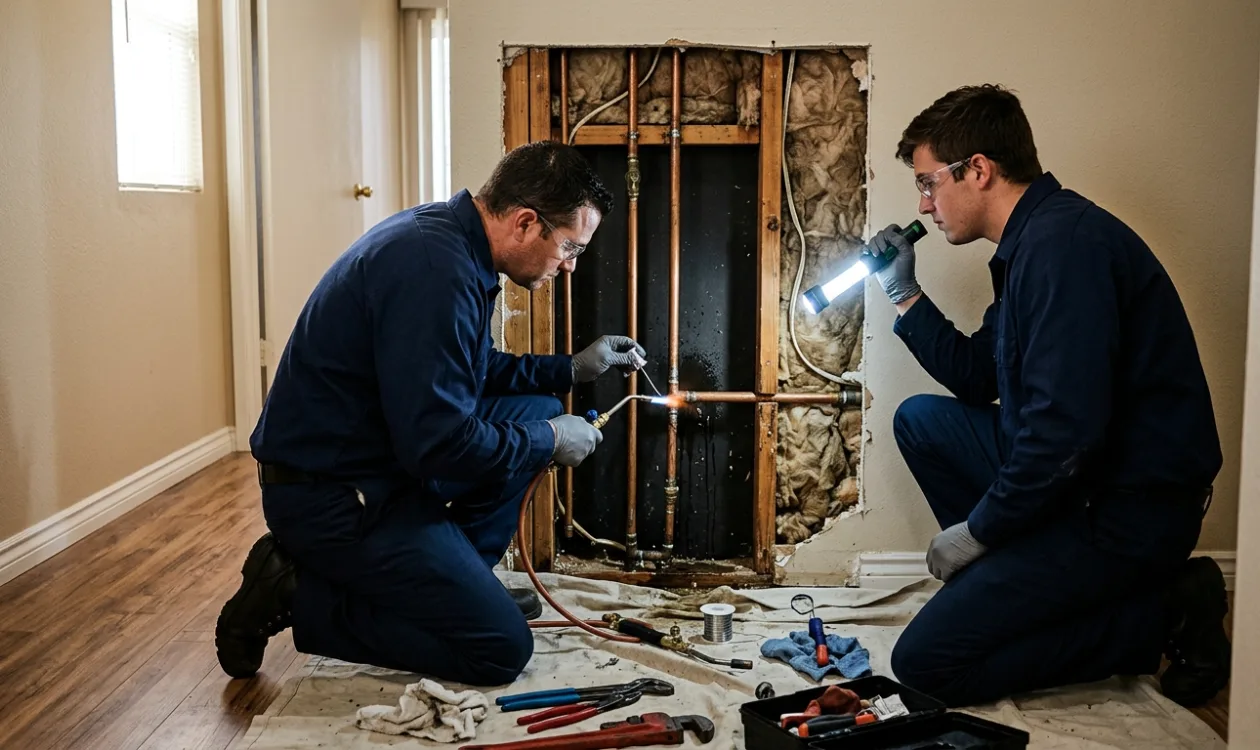
92845 · west of Valley View Street
The tracts west of Valley View are almost all slab-on-grade, built in one long stretch of the late fifties and sixties. That single fact predicts most of what goes wrong here, and it is why the first question a good pro asks is where the water is showing up rather than what the fixture is doing.
Warm spot on the floor, a meter that will not stop turning, or hot water that ran out for good.
Get a West Garden Grove Pro DispatchedWest Garden Grove is the part of the city between Valley View Street and the Los Alamitos and Cypress boundaries, running roughly from Katella Avenue down past Lampson and Chapman. It filled in fast during the post-war boom, and the houses reflect that: single story, three or four bedrooms, attached garage, generous lot by Orange County standards, and a concrete slab poured directly on grade.
Slab construction was a cost and speed decision at the time, and for the first thirty or forty years it was a good one. There is no crawlspace to rot, no subfloor to sag, no pier and post to settle. The trade-off arrives later, and it arrives here now: the water supply lines run through or beneath that slab, and when one of them fails there is six inches of concrete between the leak and anyone who wants to fix it.
Most of these houses were plumbed in soft copper. Copper is a good material and it lasted well, but it does not last forever under a slab. Three things wear it out. The first is abrasion, where the pipe rubs against the concrete or against a rock in the fill every time it expands and contracts with hot water. The second is electrolysis, a slow chemical attack where dissimilar metals or stray current meet damp soil. The third is simple pinhole corrosion from the inside, accelerated by hard water and by pressure that has been running higher than it should.
The result is a pinhole leak, usually on a hot line, usually announced by a warm patch on the floor before it is announced by anything else. Homeowners often notice it with bare feet in a hallway. By the time a water bill jumps, the leak has typically been running for a billing cycle.
The honest conversation on the west side is not usually about whether one leak can be repaired. It can. It is about whether repairing one pinhole in a fifty-year-old copper system under concrete is money well spent. If the pipe has failed once from age, the rest of it is the same age. A second leak within eighteen months is common enough that many owners here move straight to a reroute or a full repipe the first time, running new lines overhead through the attic and abandoning the slab pipe in place.
That is a bigger job and a bigger number, and nobody should be pushed into it. But it should be on the table with real figures next to the spot-repair figure, because the comparison is the whole decision.
The other signature of the area is trees. Sixty years of growth in the parkway and the front yard means root systems that have found the sewer lateral. Clay pipe with mortared joints was standard at the time, and roots exploit those joints as a reliable source of water and nutrients. The symptom is a drain that clears with a cable and then backs up again the following season, which is the classic pattern of a root problem rather than a grease or paper blockage.
A camera inspection settles it in twenty minutes, and it is worth doing before agreeing to anything larger. It shows whether the pipe is intact with roots at the joints, which can often be jetted and maintained, or whether the pipe has actually collapsed or offset, which needs a repair or a trenchless liner.
Quick facts
If you suspect a slab leak, shut every fixture in the house, then look at the water meter. If the low-flow indicator is still creeping, water is escaping somewhere between the meter and the fixtures. That single observation saves a lot of time on the phone.
Slab leaks do not get better on their own, and the damage curve is steep after the first week.
On the ground here
The mix of calls on the west side is distinctive enough that it is worth spelling out. Slab leak detection leads by some margin. After that comes water heater work, then sewer lateral problems, then the fixture and drain jobs that every neighborhood generates.
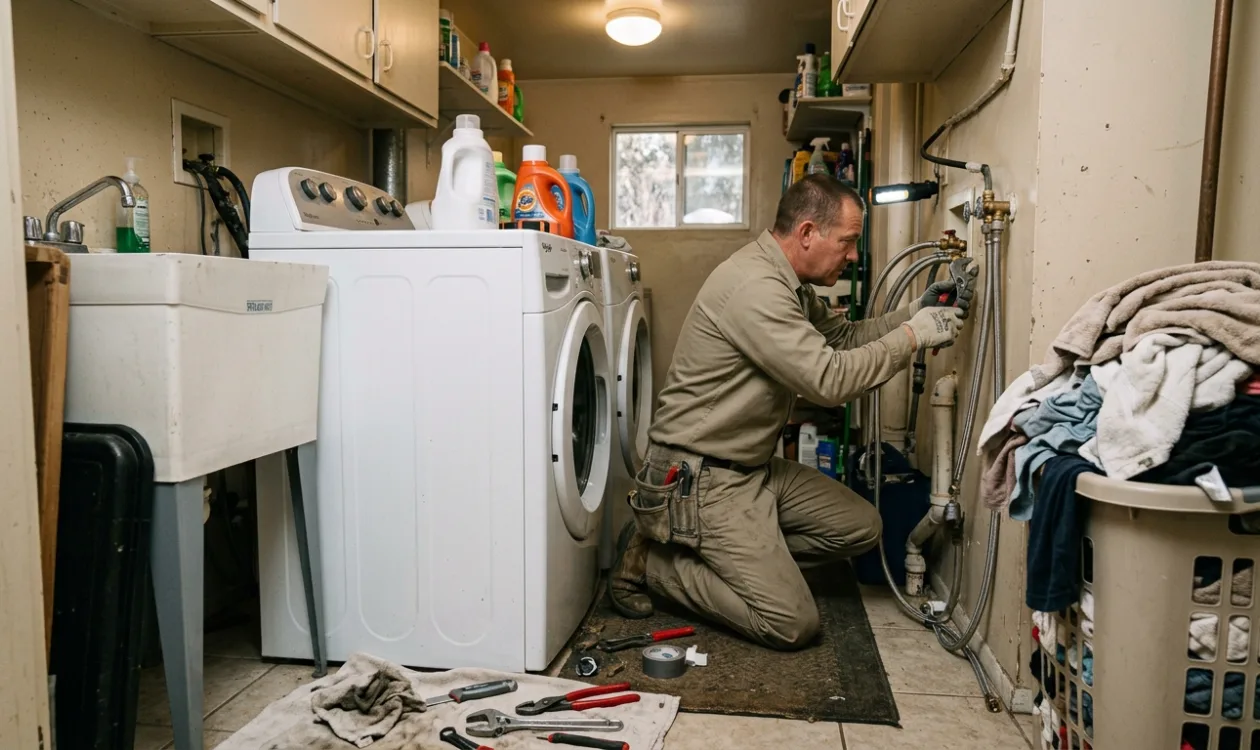
These houses put the water heater in the garage, usually in a shallow alcove near the laundry hookups. That location matters for three reasons. It means the unit is on a platform or should be, it means seismic strapping is visible and inspectable, and it means a failure floods a garage rather than a hallway, which is a mercy. Tanks in these homes are frequently on their third or fourth replacement. If yours has a manufacture date more than twelve years back, it is living on borrowed time.
Distribution pressure in parts of the west side sits comfortably above what a house should see, which is why virtually every home has a regulator near the front. Those regulators have a service life of ten to fifteen years and a great many of them are past it. A failed regulator is often the hidden cause behind a dripping heater relief valve, banging pipes and a run of burst washing machine hoses.
Room additions and garage conversions are common on these larger lots, and so are accessory dwelling units. Any of those involve plumbing that has to be permitted and inspected by the City of Garden Grove. It is worth confirming that whoever quotes the work is pulling the permit rather than treating it as optional, because an unpermitted bathroom addition becomes a real problem at the point of sale.
Orange County water is hard, and it shows up on the west side the same way it does everywhere else in the city: scale in the heater, shortened fixture cartridge life, spotting on glass, and stiff regulators. Softeners and whole-house filtration are a routine request here, and the practical question is usually where the loop is and whether one exists at all.
Most requested here
Warm floors, running meters and pinholes in fifty-year-old copper under concrete.
Read moreOverhead reroutes that retire slab pipe rather than patch it a second time.
Read moreGarage alcove replacements with strapping, pan and expansion done properly.
Read moreAcoustic and thermal location before anyone opens concrete.
Read moreRoot intrusion at clay joints under mature parkway trees.
Read moreAging regulators behind burst lines and dripping relief valves.
Read moreHow a call works
Slab work is the local specialty, and the sequence is always locate first, open second.
Bring the meter reading if you took one. It moves the diagnosis along quickly.
Cross street, house age and what you are seeing. Slab-era tracts get matched with a pro who carries detection gear.
Acoustic listening, thermal imaging and pressure isolation narrow it to a spot before any concrete is touched.
Spot repair, reroute of the affected line, or full repipe. Real numbers for each, and the reasoning behind them.
Repair completed, system pressure tested, and the concrete patched back. Permits pulled where the scope requires.
Local questions
Slab leaks, repipes and what fifty-year-old copper is realistically worth repairing.
The classic signs are a warm or damp patch on the floor, the sound of running water with everything off, an unexplained jump in the water bill, and a water meter low-flow indicator that keeps moving when nothing is on.
Not all of those appear together. A cold-line slab leak produces no warm spot at all, which is why detection equipment rather than observation is what confirms it.
Often yes. If the affected line can be isolated, a reroute runs new pipe overhead through the attic and down the walls, abandoning the slab section entirely. No concrete is opened.
A direct spot repair means cutting and patching the slab. Which approach makes sense depends on where the leak is, how many fixtures the line serves and the condition of the rest of the system.
If the copper is original and this is the first failure, a spot repair is defensible. If it is the second failure, the maths usually favors a repipe, because you are otherwise paying detection and concrete costs repeatedly on a system that is uniformly worn.
A good pro gives you both numbers and tells you plainly which they would choose in your position.
A typical single-story West Garden Grove home is usually a two to four day job depending on the number of bathrooms and how the attic runs.
Water is off for parts of each day rather than the whole time, and drywall patching adds a day or two at the end.
A blockage that returns on a seasonal cycle is almost always roots rather than debris. Cabling clears a channel through the root mass, water flows, and the roots grow back into the same joints.
A camera inspection shows whether the pipe is sound enough to maintain with periodic jetting or whether the lateral needs replacing or lining.
Yes, and it is under-diagnosed. Sustained pressure above eighty psi shortens the life of supply lines, fill valves, cartridges and the water heater itself.
A gauge on an outside hose bib gives you the number in thirty seconds. If it reads high, the regulator is the thing to look at.
Replacement water heaters in Garden Grove generally require a permit and an inspection, which covers strapping, the pan and drain, venting and the expansion arrangement.
That is a feature rather than a nuisance. It is the mechanism that catches a bad install before it becomes a flooded garage or a combustion problem.
Sometimes. Additions and garage conversions often mean plumbing of a different era and material tied into the original system, and the joint between the two is a common failure point.
Say so when you call. It changes what the pro expects to find behind the wall.
Next door
Two-story homes a short drive east with their own pressure quirks.
Commercial frontage running east from the west side.
Just north, similar vintage, more multi-family.
Directly south, shares construction era and distribution zones.
92845 · answered day and night
The sooner a slab leak is located, the smaller the repair and the smaller the damage bill behind it.