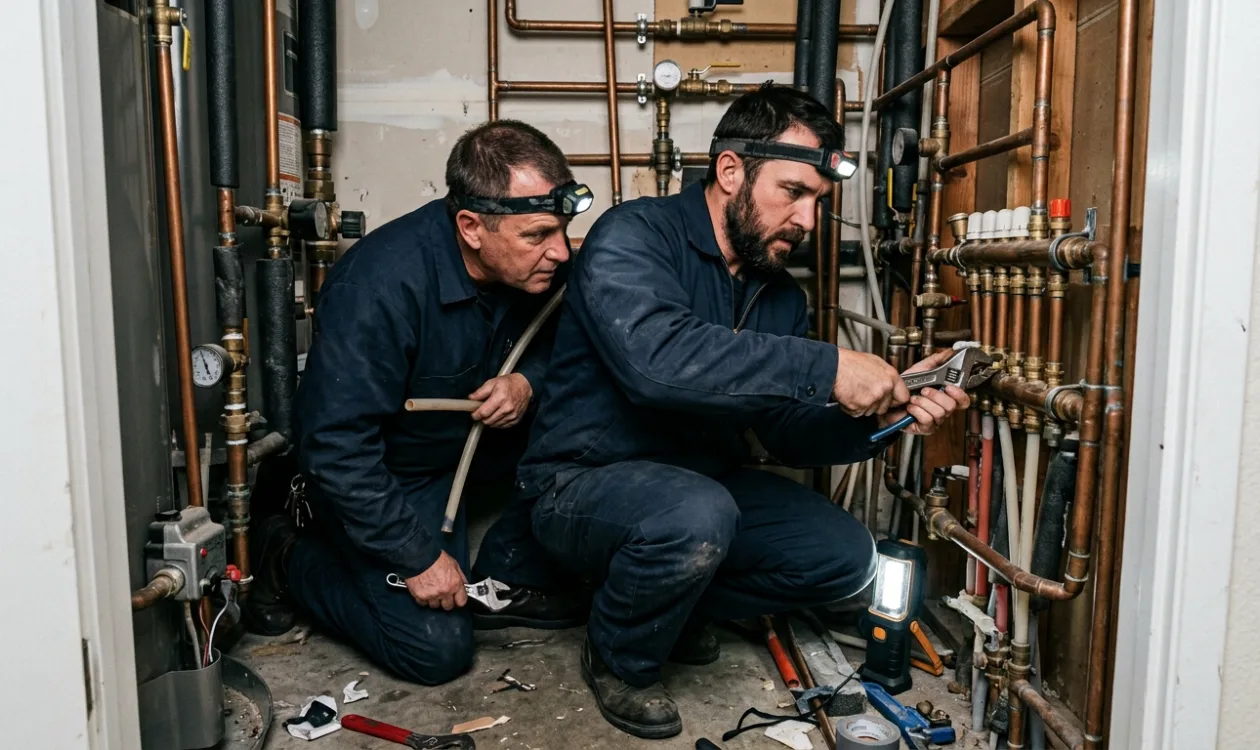
Whole-home repiping
Repipes change pressure behavior and include a regulator check.
Read more
Pressure · regulators · water hammer
High water pressure is the quiet cause behind a surprising share of plumbing failures, burst supply lines, dripping relief valves, short water heater life. A gauge on a hose bib answers it in thirty seconds. We connect you with a local pro who reads it and fixes the cause.
Banging pipes, a dripping relief valve, or fixtures that blast, all point the same direction.
Call (657) 354-1942 About Water PressureResidential water pressure should sit somewhere between about 50 and 70 psi. Below 40 and fixtures feel weak; above 80 and the plumbing code says something has to be done about it, because sustained high pressure is genuinely destructive. Garden Grove sits in a distribution system where street pressure in some areas runs well above what a house should see, which is precisely why almost every home here has a pressure regulator on the main.
A regulator is a spring-loaded brass valve, usually just past the shut-off near the front of the house or in a box near the meter. Its job is to take whatever the street gives and hold the house at a set figure. It is a mechanical part with a diaphragm and a spring, and it has a service life of roughly ten to fifteen years. When it fails, it fails in one of two directions, and the symptoms are opposites.
This is the common and expensive one. The regulator stops regulating and the house sees street pressure. What you notice: faucets that blast rather than flow, toilets that fill fast and loudly, a banging sound when a valve closes, and the temperature-and-pressure relief valve on the water heater dripping onto the garage floor. That last symptom in particular sends people looking for a bad water heater when the actual fault is thirty feet away on the main.
What you do not notice is the cumulative damage. High pressure shortens the life of every flexible supply line, every fill valve, every cartridge, every appliance solenoid and the water heater itself. Burst washing-machine hoses and split toilet supply lines are very often a pressure story rather than a hose story.
The other failure mode. The regulator clamps down and the whole house runs weak, every fixture, hot and cold alike, all the time. That last part is the useful distinguisher. If only the hot side is weak, look at the water heater and its connections. If only one fixture is weak, look at that fixture. If everything in the house is weak simultaneously, look at the regulator, the main shut-off, and the supply pipe.
A bang when a faucet or an appliance valve closes is water hammer, moving water stopping abruptly and slamming against a closed valve. High pressure makes it worse and louder, so correcting pressure often solves it. But loose pipe straps in a wall, missing hammer arrestors on fast-closing appliance valves, and long unsupported runs also produce it. The diagnosis is a pressure reading first, and then a look at how the pipe is supported.
A regulator is a one-way device. When water in a closed system heats and expands, it has nowhere to go back to, and pressure spikes. That is why an expansion tank belongs on a system with a regulator and a tank water heater, and why a heater relief valve that drips only after a heating cycle points at a missing or failed expansion tank rather than a bad relief valve. Replacing the relief valve without addressing expansion is a repair that comes back.
A screw-on pressure gauge costs very little at any hardware store. Fit it to an outdoor hose bib, open the tap fully, and read it with nothing else running.
Under 80 psi is what code expects. Anything sitting above that is shortening the life of everything in the house.
A water heater relief valve that drips after a heating cycle usually means high pressure or a missing expansion tank, not a bad relief valve.
A gauge on the hose bib is a thirty-second test that settles a lot of arguments.
How the visit goes
Pressure work is one of the most measurable jobs in plumbing. There is a number before and a number after.
Describe What the Pipes DoBanging on shut-off, a hum, or a thump when the washer fills. Each sound means something specific.
A gauge goes on a hose bib with nothing running, and the reading is taken and shown to you.
Pressure is watched with fixtures open and closed to see whether the regulator holds, sags or spikes.
Regulator, main shut-off, supply pipe, expansion, or pipe support, the reading and the pattern narrow it to one.
The repair is made, the pressure is re-read in front of you, and the figure is left set where it belongs.
Local specifics
Pressure is not uniform across the city, and elevation is the reason. Distribution pressure is set to serve the highest and furthest points on a zone, which means houses lower in the same zone see more than they need. The practical consequence in Garden Grove is that some streets read comfortably in the sixties at the hose bib while others read over 100 psi with a failed regulator. If a neighbor has had two burst supply lines and you have had one, that is a pattern worth testing rather than a coincidence.
Age is the other factor. Regulators installed with the original construction in the fifties and sixties have long since been replaced, usually once, sometimes twice. What we see most often is a regulator from a repipe or a remodel fifteen to twenty years ago that is now at the end of its own life. Ten to fifteen years is the realistic expectation, and a regulator that old is a maintenance item rather than a failure.
Hard water shortens that further. Mineral deposits build on the diaphragm and the seat, and a regulator that has been sitting at one setting for years can seize at exactly the moment somebody tries to adjust it. That is why adjusting an old regulator is sometimes possible and sometimes turns into a replacement, and why a pro tells you which they expect before touching the adjusting screw.
Whole-home repipes are common in this city, and a repipe changes pressure behavior. New smooth pipe with no corrosion restriction delivers everything the main gives it, so a marginal regulator that was masked by fifty years of narrowed galvanized pipe suddenly reveals itself as high pressure at every fixture. Any decent repipe includes a pressure check and a regulator assessment for exactly that reason.
Many properties here have irrigation teed off before the regulator, which is normal, and sometimes teed after it, which affects house pressure when a zone runs. If your indoor pressure drops noticeably when the sprinklers come on, the plumbing arrangement is worth reviewing. The same applies to automatic pool fill lines.
In two-story houses the upstairs fixtures see less pressure than the downstairs ones simply because of height, roughly half a psi per foot. A regulator set for comfortable upstairs showers can leave downstairs fixtures running hard. Balancing that is part of setting the regulator properly rather than just installing it at the factory default.
Pressure questions
How to test it, what the number should be, and what high pressure is costing you.
Between roughly 50 and 70 psi is the comfortable, sensible range for a house. Plumbing code treats anything above 80 psi as needing correction.
Below about 40 psi fixtures start feeling weak, particularly upstairs and when two are running at once.
Buy a screw-on pressure gauge from any hardware store, fit it to an outdoor hose bib, open the tap fully, and read it with nothing else in the house running.
Take a second reading in the evening if you can. Street pressure often rises at night when demand drops, and that peak matters.
Most often because system pressure is too high, or because thermal expansion has nowhere to go. The relief valve is doing its job by discharging.
Replacing the relief valve without fixing pressure or fitting an expansion tank means the same drip returns. The pressure reading comes first.
It is water hammer, and while a single bang will not burst a pipe, sustained hammer works joints and fittings loose over time.
High pressure makes it worse, so a pressure correction often resolves it. Loose pipe straps and missing hammer arrestors on appliance valves are the other causes.
Ten to fifteen years is realistic. Hard water shortens it, because mineral deposits build up on the diaphragm and the seat.
A regulator older than fifteen years that is being blamed for a pressure problem is usually best replaced rather than adjusted.
Sometimes, yes. If the valve is sound and simply set wrong, the adjusting screw moves it and a gauge confirms the result.
If the diaphragm has failed or the internals are scaled, adjustment does nothing or makes the leak worse. The pro will tell you which case you have before turning anything.
It is one of three main candidates, along with a partially closed main shut-off and a restricted supply pipe. A regulator that has failed closed produces exactly that whole-house weakness.
A pressure reading distinguishes them quickly, which is why it is always the first step.
If you have a pressure regulator and a tank water heater, yes. The regulator makes the system closed, so heated water expanding has nowhere to go and pressure spikes.
A small tank absorbs that. It is inexpensive and it prevents a whole category of nuisance leaks.
Very often. High pressure is the common factor behind burst washing-machine hoses, split toilet supply lines, weeping angle stops, failing fill valves and shortened water heater life.
Fixing the individual failures without correcting pressure means paying for them repeatedly.
It depends on access and on the condition of the main shut-off next to it, a seized shut-off that has to be replaced at the same time is the usual variable.
Call (657) 354-1942 with your gauge reading if you have one. It shortens the diagnosis considerably.
Pricing
Valve, fittings, shut-off replacement if needed, and a verified pressure reading afterwards, one number.
Ask What a Regulator CostsRelated work
Repipes change pressure behavior and include a regulator check.
Read moreDripping relief valves and shortened heater life.
Read moreWhen high pressure has already caused a leak you cannot see.
Read moreWhere we do this work
Two-story homes needing balanced settings.
Older regulators well past service life.
Repiped houses revealing high pressure.
Neighboring city, same distribution zones.
Garden Grove & northwest Orange County
Every day at high pressure is wear on every fixture, line and appliance in the house.
Have the Pressure Corrected