Water heater repair
Before you replace, whether the fault is actually repairable.
Read more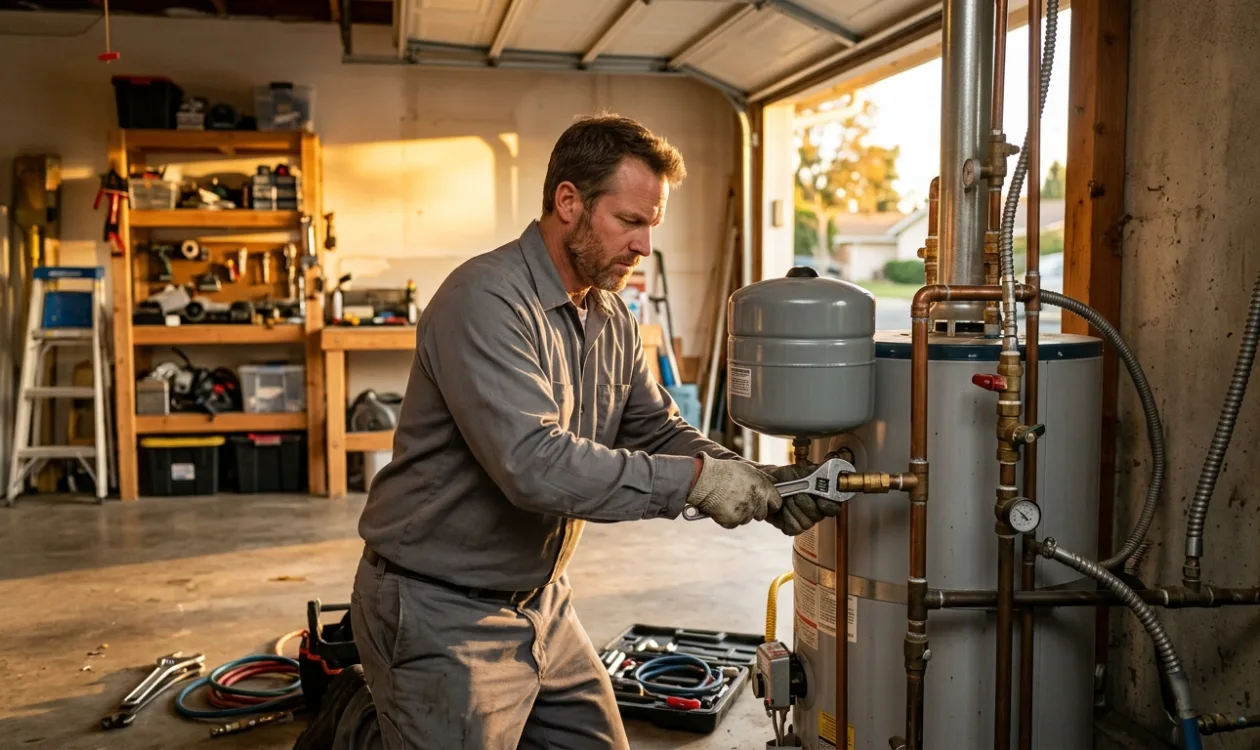
Sized, strapped, permitted
Replacing a heater is not just swapping a box. Sizing, venting, combustion air, seismic strapping, expansion control and a permit all belong in the job, and all of them get skipped by someone offering to do it cheap.
Bathroom count and household size are all we need to start sizing it properly.
Call (657) 354-1942 for a ReplacementA water heater replacement looks simple from the outside: disconnect the old one, connect the new one. The difference between a good installation and a cheap one is entirely in the parts of the job that are not the appliance.
Undersizing produces the exact complaint that made you replace the last one. Sizing is not just tank capacity; it is first-hour rating, which combines stored volume with recovery rate. A household with two bathrooms and a morning rush needs different numbers from a household of two. Oversizing has its own cost, standing heat loss on a tank that never gets emptied, and in a closet installation it may not physically fit or may compromise combustion air.
Gas heaters need to exhaust safely and to draw enough air to burn. Atmospheric units rely on natural draft through a flue, and that flue has to be correctly sized, pitched and connected, a heater slid into place with a poorly seated vent connector is a carbon monoxide risk, not a plumbing shortcut. Where a new unit differs in input from the old one, the venting may need to change. In closet and interior installations, combustion air openings must actually be there and be unobstructed.
California requires water heaters to be braced against earthquake movement, with straps at upper and lower thirds anchored into structure rather than into drywall. It is a small part of the cost and one of the most commonly botched details in older local installations.
In a house with a pressure regulator or check valve, the plumbing system is closed, and heated water that expands has nowhere to go. That drives pressure up until the relief valve discharges. A thermal expansion tank, correctly pre-charged to the system pressure, is what prevents it. If your old heater's relief valve dripped, this is very often the reason, and installing a new heater without addressing it reproduces the problem.
Flexible connectors rated for potable water, a working cold-side shut-off valve, dielectric protection where dissimilar metals meet, a properly routed relief valve discharge line terminating somewhere safe, a drain pan with a routed drain in any location where a leak would damage finishes, and sediment trap and gas connection details done correctly on the fuel side.
Water heater replacement generally requires a City of Garden Grove permit and inspection. It exists precisely because the failure modes of a bad installation (combustion products in a living space, an unrestrained tank, an uncontrolled pressure vessel) are serious. An inspection is a second set of eyes on work that is about to be closed up behind an appliance.

Unit, labor, venting, strapping, expansion tank, pan and drain, permit, haul-away. A cheap number usually means several of those are missing.
Not just gallons. Recovery rate matters as much as capacity for a household with a morning rush.
If your old relief valve dripped, this is likely why. A new heater without expansion control will do the same thing.
Any installation where a leak would reach finished flooring or a neighboring unit needs a pan and a routed drain, not just a tray.
One number covering unit, install, code items, permit and haul-away.
How the install runs
Most standard replacements are a single-day job with the water back on the same evening.
Talk Through Tank OptionsCapacity, recovery rate, gas or electric, and whether tankless is worth considering.
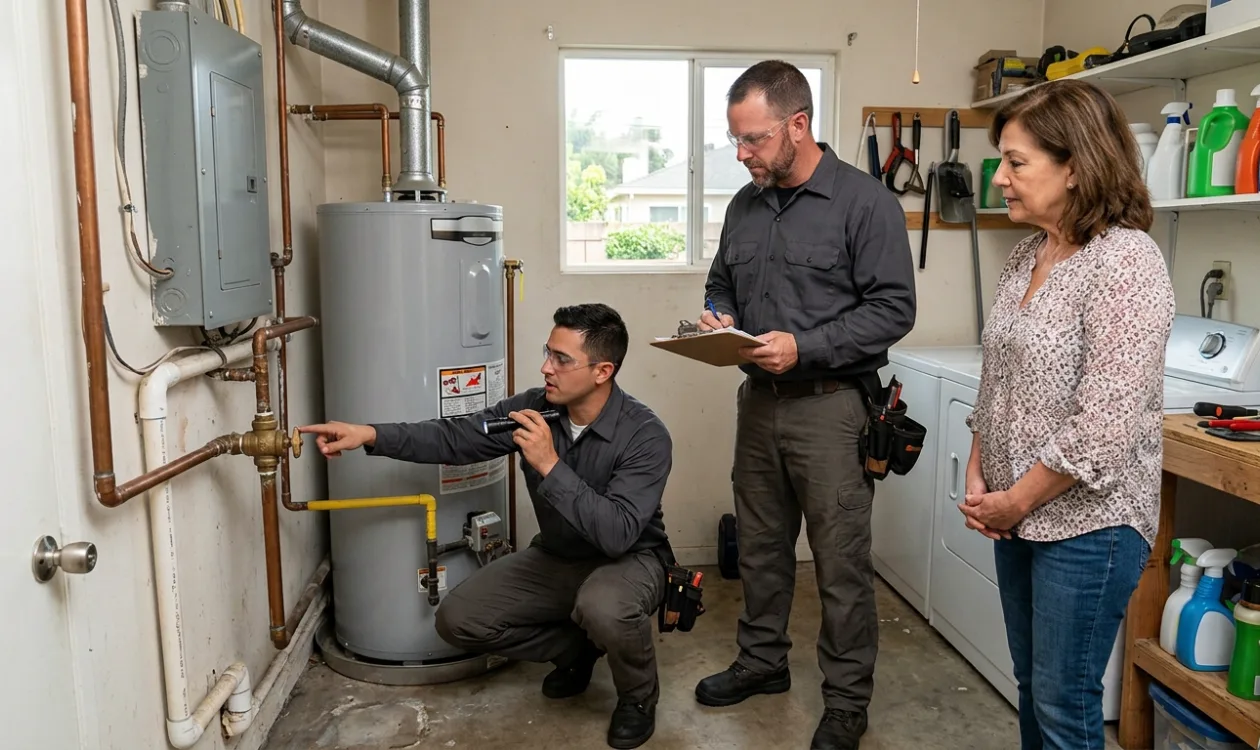
Household demand, fixture count, fuel type, physical space and venting assessed, then a specific unit recommended with reasons.
Permit filed, water and fuel isolated, old tank drained and hauled away rather than left in your garage.
New unit set, connected, vented, strapped at upper and lower positions, with expansion control, pan and relief discharge all done properly.
Filled and purged, temperature set, leak-checked under pressure, combustion verified, then city inspection completed.
Choosing the unit
Conventional gas storage is the default across Garden Grove's postwar housing for good reasons: it is the least expensive to buy and install, it fits the space and venting that already exist, it recovers quickly, and it works during a power outage. Its weaknesses are standing heat loss, a finite volume, and vulnerability to the sediment that local hard water produces. For a straight replacement in a garage, it is very often the sensible answer.
Electric storage makes sense where there is no gas at the location (some condo and townhouse closets, some ADU conversions) or where an owner is moving away from gas. Recovery is slower and running costs differ, and a heat-pump variant changes that arithmetic significantly.
Heat-pump (hybrid) units are dramatically more efficient and are increasingly attractive, but they need air volume and they cool the space they draw from, which makes a garage a reasonable host and a small interior closet a poor one. They are taller than the tanks they replace, so clearance needs checking, and they need condensate drainage.
Tankless deserves its own conversation, and it has one on its own page. In brief: endless hot water, small footprint, high efficiency, and a real requirement for annual descaling in this water. Retrofitting usually means gas supply and venting changes, which is where the cost lives.
In the 1950s and 60s tracts, heaters sit in attached garages with atmospheric venting through the roof. Space is usually generous, which makes upsizing or switching type straightforward, and the slab underneath tolerates a leak better than a finished floor would. The recurring issues are lint-blocked intakes, vehicles crowding the unit, and strapping that was never done properly.
In the older craftsman housing near the core, installations are often in tighter service porches or exterior closets, sometimes with venting that was adapted decades ago. Replacements there need the venting looked at honestly rather than reused by default, and space frequently constrains capacity, which is one situation where tankless earns its place.
In condo and townhouse units, closet installations bring tighter combustion air and venting rules, restricted physical dimensions, and a finished floor (or a neighbor's ceiling) under the tank. Pan and routed drain are not optional there, and association rules may govern what can be installed.
In ADU conversions, which are happening across the city, the heater is a new installation rather than a replacement, so gas supply sizing, venting routes and space planning all get decided from scratch. That is the moment to consider tankless or heat-pump on the merits rather than defaulting to a tank.
Capacity and type first. Then whether the venting can be reused or must be modified. Then code items that may not currently exist, expansion tank, pan and drain, strapping, a new shut-off. Then access: a garage on a slab is easy, a second-floor closet with a narrow stair is not. And finally the permit, plus haul-away of the old unit.
Installation questions
Mostly about sizing, and about why quotes differ so much.
Sizing works on first-hour rating, which combines stored volume with how fast the unit reheats. A two-bathroom household with a concentrated morning demand needs a different figure from a couple who shower at opposite ends of the day. Bathroom count, occupancy and peak usage pattern are what a plumber will ask about, and the answer should be a specific unit rather than a generic gallon figure.
Almost always because of what is or is not included. Venting modifications, seismic strapping, a thermal expansion tank, a drain pan and routed drain, a new shut-off valve, the permit, and haul-away of the old tank are all real line items. A quote that is dramatically lower is usually a quote that omits several of them, and you find out at the inspection.
Replacement generally requires a City of Garden Grove permit and inspection. It is not bureaucratic decoration, the inspected items are combustion venting, seismic restraint, pressure relief and gas connection, which are exactly the details that make a bad installation dangerous rather than merely disappointing.
Water expands when heated. In a house with a pressure regulator or check valve the plumbing is a closed system, so that expansion has nowhere to go and pressure climbs until the relief valve discharges. A properly pre-charged expansion tank absorbs it. If your previous heater’s relief valve used to drip, this is very often the explanation.
For standard sizes and a straightforward garage replacement, usually yes. Same-day gets harder when the venting needs modification, when the unit is an unusual size or fuel type, or when access is difficult. Tell us the capacity and location on the phone and you will get a realistic answer.
It is worth considering rather than assuming. Tankless gives endless hot water and a small footprint, and it suits tight installations well. The costs are a larger gas supply and different venting in most retrofits, plus annual descaling, which in this hard water is a genuine commitment rather than optional. If the current location is a spacious garage with adequate venting, a good tank is often the better value.
Yes, and confirm it is in your quote. Removal and disposal should be included as standard. An old tank left standing in your garage is not a saving.
Around 120 degrees Fahrenheit is the common recommendation, balancing scald risk against bacterial growth in stored water, and it also slows scale formation in hard water. Households with specific medical or appliance requirements sometimes go higher, in which case mixing valves at fixtures are worth discussing.
Yes, several things. Combustion air and venting requirements are tighter, physical dimensions constrain what will fit, and there is finished flooring (or in a condo a neighbor’s ceiling) beneath it, so a drain pan with a routed drain becomes important rather than optional. In shared-wall buildings, association rules may also govern the installation.
With local water hardness, eight to twelve years is a realistic expectation for a storage tank, and maintenance moves that figure meaningfully. Annual flushing and replacing the anode rod when consumed are the two things that matter most. Adding softening or filtration protects the heater and everything else scale damages.
What the price includes
The gap between quotes is almost always the code work, not the appliance.
Ask What Is IncludedRelated work
Before you replace, whether the fault is actually repairable.
Read moreThe alternative worth pricing when space is tight or demand is high.
Read moreHigh pressure shortens heater life and makes relief valves discharge.
Read moreWhere we do this work
Roomy garage installations across the ranch tracts.
Tighter service porches in older homes.
Mixed housing off Chapman Avenue.
Neighboring tract housing, same install patterns.
Garden Grove & northwest Orange County
Same-day replacement is usually possible on standard sizes.
Tank Finally Given Out?