Slab leak repair
Often the failure that starts the repipe conversation in a slab home.
Read more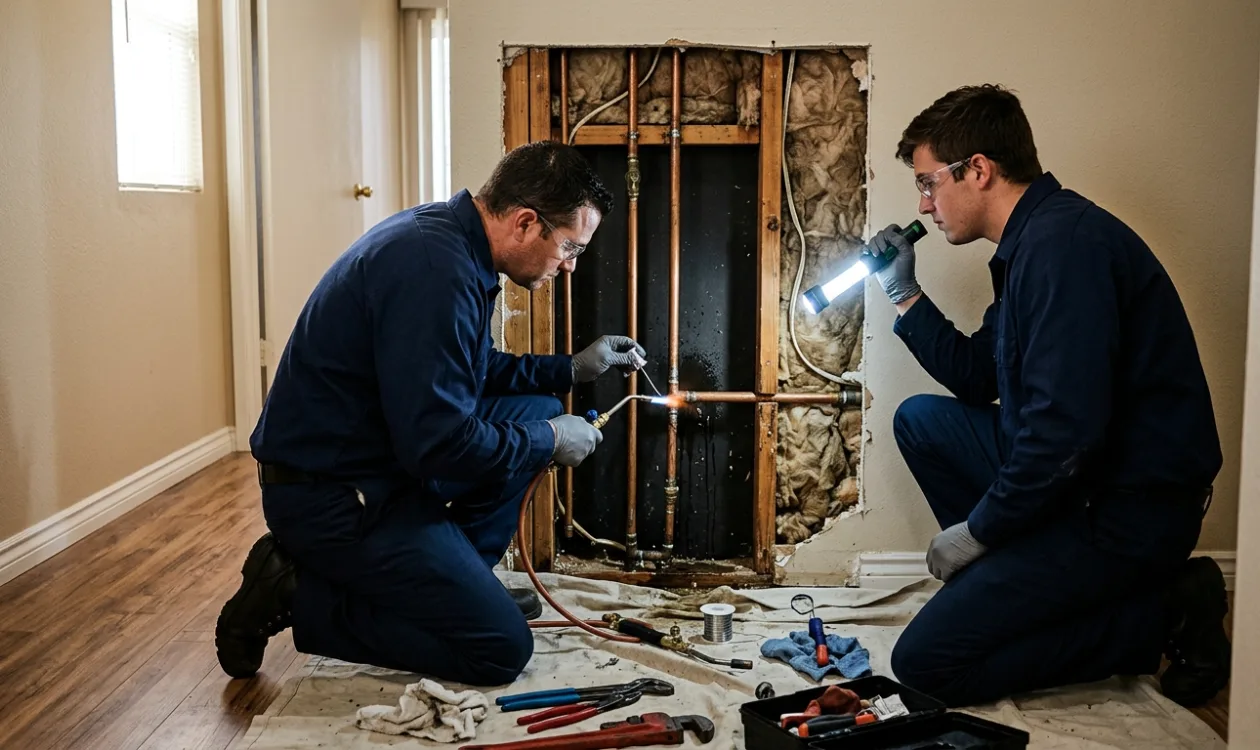
When patching stops making sense
Two pinholes in a year, brown water on the first draw, pressure that dies when someone starts a shower. At some point the honest answer stops being another repair and becomes replacing the supply system.
How many leaks in the last two years? That number usually decides this on its own.
Call (657) 354-1942 About a RepipeRepiping replaces the pressurized supply system inside a house (the pipes carrying potable water from where the service line enters to every fixture) while leaving the drain system alone. Drains and supply are separate systems with separate failure modes, and it is entirely normal for a house to need one and not the other.
The decision is not about age in isolation. It is about the pattern of failures and what the removed pipe looks like.
Repeat pinhole leaks. One leak is an event. Three in two years, in different parts of the house, is a system telling you its wall thickness is gone. When a plumber cuts out a failed section and the copper is uniformly thin rather than damaged at one spot, every other run is on the same timeline.
Discolored water on the first draw. Rusty or brown water that clears after running for a few seconds indicates corrosion products sitting in the pipe. In galvanized systems this is the interior of the pipe arriving at your tap.
Pressure that collapses under load. Not low static pressure, but pressure that vanishes when a second fixture opens. That is the signature of a restricted bore, galvanized pipe silted up internally, sometimes to the diameter of a pencil. No fixture cleaning or regulator adjustment fixes it, because the pipe itself is the restriction.
Visible corrosion at accessible joints. Green crust on copper, flaking rust and weeping at galvanized threads under a sink or in a garage. What is visible is a sample of what is not.
A slab leak in a house with under-slab distribution. Sometimes the trigger. If the copper under the concrete has begun failing and the same vintage of pipe runs everywhere, rerouting one line at a time is a series of projects. A repipe does all of it once and moves the whole system somewhere accessible.
New pipe is routed through accessible paths (attic space, interior wall cavities, occasionally a crawl space) rather than following the old routes. Access holes are cut in drywall at strategic points, typically high on walls and in closets where patching is least conspicuous. The new system is built out to each fixture group, tied in at the service entry, pressure tested before anything is closed, then inspected under permit. Old lines are isolated and abandoned in place; there is no benefit to demolishing walls to remove them.
Most single-story Garden Grove tract homes are a two to four day job for the plumbing itself. Two-story and larger homes take longer. Water is off during working hours and generally restored each evening, though there will be at least one full day without water while the changeover happens.

Write down every leak and repair in the last three years with dates. That list is the most persuasive diagnostic there is.
A section of removed pipe cut lengthwise shows wall thickness and internal buildup. It answers the repipe question better than any argument.
Repiping means drywall access holes. Plumbers patch to varying standards, clarify who does the drywall, texture and paint before you sign.
Repiping requires a City of Garden Grove permit and inspection. That is protection for you, and it should appear as a line item.
A walkthrough that counts fixtures, checks pressure and looks at what the pipe actually is.
How a repipe runs
A defined project with a schedule, not an open-ended series of repairs.
Weigh Copper Against PEXBoth are legitimate. The right answer depends on your house, not on fashion.
Every fixture counted, pipe material confirmed, pressure measured, and the routing planned before a price is given.
Holes cut where patching is least visible (high on walls, in closets, above cabinets) rather than wherever is quickest.
New copper or PEX run to each fixture group through accessible paths, with proper support, insulation on hot runs and new stops at fixtures.
Pressure tested before closing, city inspection completed, old lines abandoned in place, then access holes patched.
Materials and local context
Copper is rigid, long-proven, unaffected by UV, and tolerant of high temperatures. It has decades of local service history, holds its value with buyers and inspectors, and can be run neatly. Against it: it costs more in material and considerably more in labor, every joint is a soldered connection, and it remains vulnerable to the same water chemistry that thinned the original copper in the first place. It is also more disruptive to install, because rigid pipe needs straighter paths and therefore more access.
PEX is flexible, so long runs can be pulled through cavities with far fewer joints and much less demolition. It resists scale buildup, tolerates freezing better, and is quieter, no water hammer transmitted through rigid tube. It is faster to install, which is where most of the cost difference sits. Against it: it must be kept out of direct sunlight, fittings are the weak point if crimped poorly, and some homeowners simply prefer metal. A manifold layout, with dedicated runs to fixture groups, is a genuine performance advantage in a house where two showers currently fight each other.
Both are legitimate. In practice, PEX wins on cost and disruption in single-story tract housing with attic access (which describes most of this city), and copper is chosen where an owner wants it, where exposure conditions demand it, or where a partial repipe has to match existing material.
Near Historic Main Street and the Village Green, early-1900s craftsman housing frequently still carries original galvanized supply. Those are the clearest repipe candidates in the city, because galvanized fails at the threads and narrows internally at the same time, poor pressure and recurring leaks arriving together.
Across the 1950s and 60s tracts, including West Garden Grove's larger-lot streets, the material is copper, often with distribution running under the slab. Those systems are now well past sixty years, and the repipe conversation there is usually triggered by a slab leak plus one or two pinholes elsewhere. A repipe in that situation has a specific extra benefit: it takes the distribution out of the concrete and puts it in the attic, where the next problem is a small drywall patch rather than a jackhammer.
In newer condo and townhouse developments, supply may be copper or early PEX and often runs through shared walls, so a unit repipe needs association coordination and careful scoping of where your plumbing ends. ADU conversions across the city are a separate driver: adding a dwelling unit means new supply runs, and it is frequently the moment owners decide to replace the main house system at the same time while walls are already open.
Fixture count is the biggest single factor, a two-bathroom house and a four-bathroom house are different projects. Then stories, since a second floor complicates routing. Then material choice. Then access: attic clearance, crawl space, and whether walls are plaster or drywall, since plaster is slower and messier to open and harder to patch. Then finishes, tile, stone and custom cabinetry all raise the cost of getting to pipe. And finally scope: new shut-off valves, a pressure regulator, a water heater connection or hose bibs replaced at the same time all add, but doing them while the system is open is far cheaper than returning later.
Repiping questions
It is a real project, and these are fair questions.
Count the failures. Three leaks in two years in different parts of the house, brown water on the first draw, or pressure that collapses when a second fixture opens all point at the system rather than a spot. The decisive evidence is a removed section of pipe: uniform thinning or a bore silted down to a fraction of its size means repairs will keep coming.
Water is typically off during working hours and restored each evening, with at least one longer stretch during the changeover. Most single-story homes here are a two to four day job; larger and two-story houses take longer. You should get a day-by-day schedule with the quote.
Most people stay. It is dusty and noisy during the day and there are stretches without water, but the house remains habitable. Households with someone working from home, or with small children napping, often find it easier to be elsewhere during the loudest days.
Both are sound. PEX is faster to install, needs far less demolition because it flexes through cavities, resists scale and costs less; that combination makes it the common choice in single-story homes with attic access. Copper is rigid, long-proven, unaffected by sunlight and preferred by some owners outright. The plumber should walk you through the trade-offs for your specific layout instead of only offering one.
Clarify this in writing before you sign, because practice varies. Some contractors patch and texture, some patch to drywall only, and some leave openings for your own contractor. None of those is wrong, but the difference matters to your budget and it is a common source of disappointment.
They are isolated, capped and left in place. Removing them would mean demolishing walls purely to extract pipe that is already out of service, which serves no purpose. Abandoned lines behind drywall are normal and expected.
Yes, and it is sometimes sensible, replacing the hot-water distribution while leaving sound cold lines, or repiping one wing where all the failures have occurred. The caution is that a partial repipe in a system that is failing generally means returning for the rest, and the second visit rarely benefits from the first visit’s efficiencies. Ask for both prices.
If the cause is restricted galvanized piping, dramatically. Removing pipe whose bore has silted down and replacing it with full-diameter runs is often the single biggest improvement an older home can get. If the cause is a failed pressure regulator or a problem in the service line, a repipe alone will not fix it, which is why pressure gets measured during the assessment.
It should be. Repiping requires a City of Garden Grove permit and inspection, and that inspection is a check on the work performed in your walls before they are closed. Any quote that proposes skipping it is proposing to take away your own protection.
Often yes, but scope and coordination matter more than in a detached house. Supply lines may run through shared walls, and the boundary between unit plumbing and common plumbing is set by the governing documents. Establish that boundary and get association approval before work is scheduled, and expect the plumber to want documentation of what is being replaced.
Cost drivers
Fixture count, stories, wall finishes and access are the four variables.
Ask What a Repipe CostsRelated work
Often the failure that starts the repipe conversation in a slab home.
Read moreThe single-point emergency that reveals a system-wide problem.
Read moreWorth replacing during a repipe, high pressure shortens any new system.
Read moreWhere we do this work
Original galvanized supply in early-1900s homes.
Older cottages near the civic core.
1960s tracts with under-slab copper distribution.
Neighboring city spanning several housing eras.
Garden Grove & northwest Orange County
Each repair on a failing system buys less time than the one before it.
Third Leak This Year?