Sewer camera inspection
The survey that decides whether your line can be lined at all.
Read more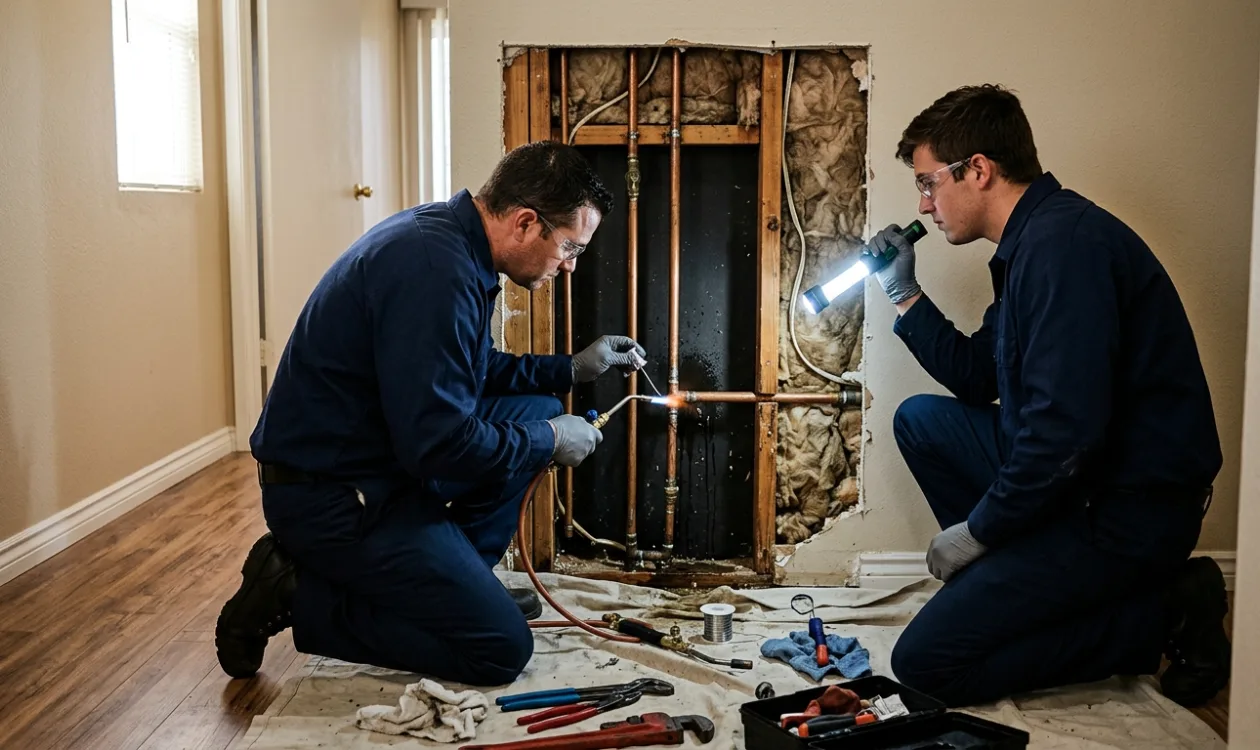
Keep the driveway, keep the tree
A failed lateral does not automatically mean a trench across your front yard. Where the host pipe still holds its shape, a liner or a burst head can replace the line from two small access pits instead.
Tell us what is on top of the line, driveway, tree, hardscape. That drives the whole conversation.
Call (657) 354-1942 for a Trenchless QuoteTrenchless sewer repair is a family of methods that replace or rehabilitate a lateral without excavating its full length. Instead of a continuous trench from the house to the street, the work happens through one or two compact access pits, and the new pipe is installed along the path of the old one.
There are two techniques that matter for residential work in Garden Grove.
A flexible liner saturated with resin is inserted into the cleaned host pipe, inflated so it presses tight against the interior wall, and cured, with heat, steam or ultraviolet light depending on the system. What sets is a continuous, jointless pipe formed inside the old one. Because it has no joints, there is nothing for roots to enter. Because it bonds to the host, it restores structural integrity to cracked pipe. The finished internal diameter is slightly smaller than the original, which on a four-inch residential lateral is essentially irrelevant to flow.
Lining requires a host pipe that still holds its shape and a line free of major offsets. It cannot bridge a collapse, it cannot correct a belly, and it will faithfully reproduce any severe misalignment it is installed through. That is why the camera survey is the gate.
Where the host pipe is too far gone to line, bursting can still avoid a full trench. A conical head is pulled through the old pipe on a cable, fracturing it outward into the surrounding soil while simultaneously drawing new HDPE pipe in behind it. The result is a brand-new, fully sized, jointless pipe on the original alignment. It needs pits at both ends and enough soil around the line to absorb the displaced fragments, so it is less suited to lines running tight against foundations or other utilities.
Garden Grove's postwar tracts were built with generous front-yard hardscape and planted with street trees that are now sixty years old. A conventional open-cut replacement across a stamped or colored concrete driveway, through established landscaping, or under a mature tree's root plate carries a restoration bill that frequently exceeds the plumbing itself. Trenchless work changes that arithmetic. It is not automatically cheaper on the plumbing line item (it often is not), but the total spend to get back to where you started is regularly lower.
Nobody arrives at trenchless repair directly. It is the answer to a lateral that has already declared itself: repeated backups on a shortening interval, waste surfacing in the lowest fixture in the house, a camera survey showing root intrusion at multiple joints or longitudinal cracking, a soft green strip along the line's route, or a sewage odor outside near the parkway.
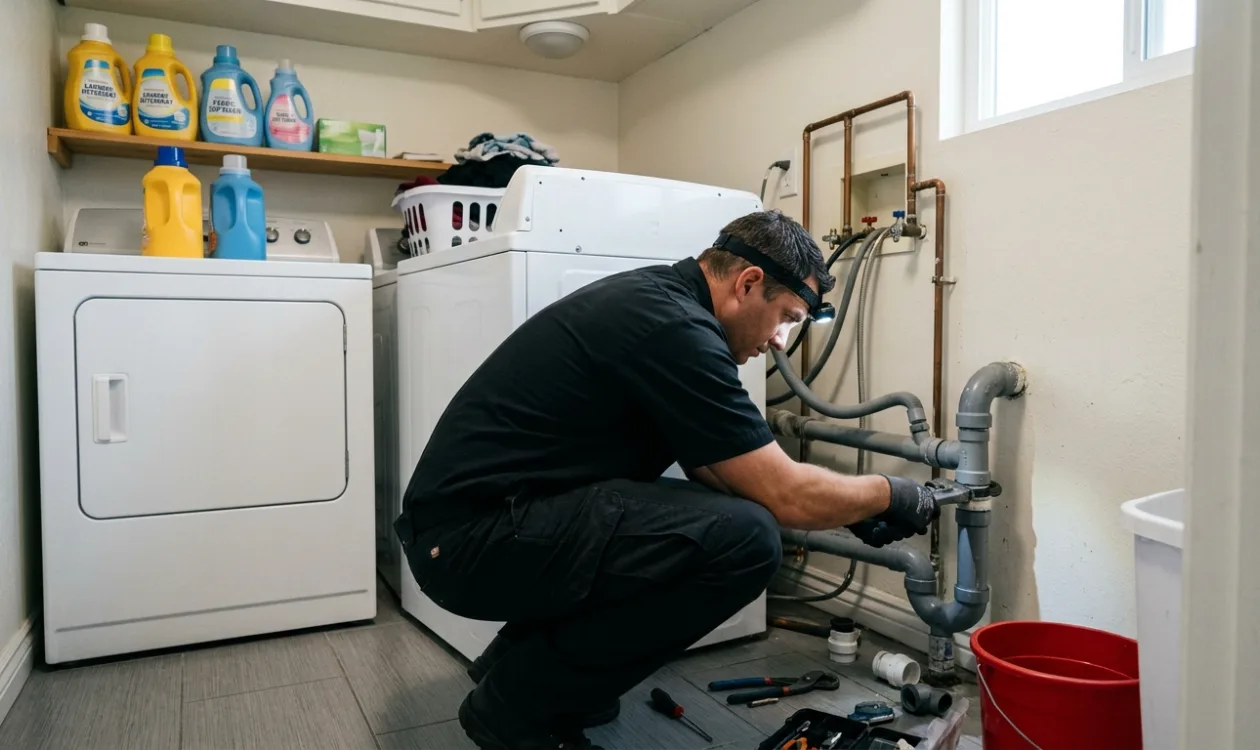
Candidacy is a technical question with a technical answer. Ask to see the footage and the reasoning, and be skeptical of anyone quoting lining sight-unseen.
A liner reduces internal bore slightly. On a residential four-inch lateral that is a non-issue; on a line already undersized for the fixture count it is worth discussing.
A liner bonds to the host pipe wall, so the line has to be jetted clean and camera-verified before installation. That is part of the job, not an extra.
Trenchless replacement generally requires a City of Garden Grove permit and inspection like any other sewer work. It should be a line item in the quote.
Not every pipe qualifies. The camera survey gives a yes or no, not a sales pitch.
How trenchless work runs
Two access pits, a day or two of work, and a lateral with no joints in it.
Compare Trenchless and Open-CutOnce restoration costs are counted the gap is often smaller than people expect.
Condition, alignment, length and depth established, and the route marked so pit locations can be planned.
The host pipe is scoured clean so the liner can bond, then camera-checked again to confirm it is ready.
One or two compact pits opened, then the liner is inserted and cured, or the burst head pulls new HDPE through.
The finished pipe is inspected end to end, city inspection completed, then pits backfilled and the surface put back.
Where it fits and where it does not
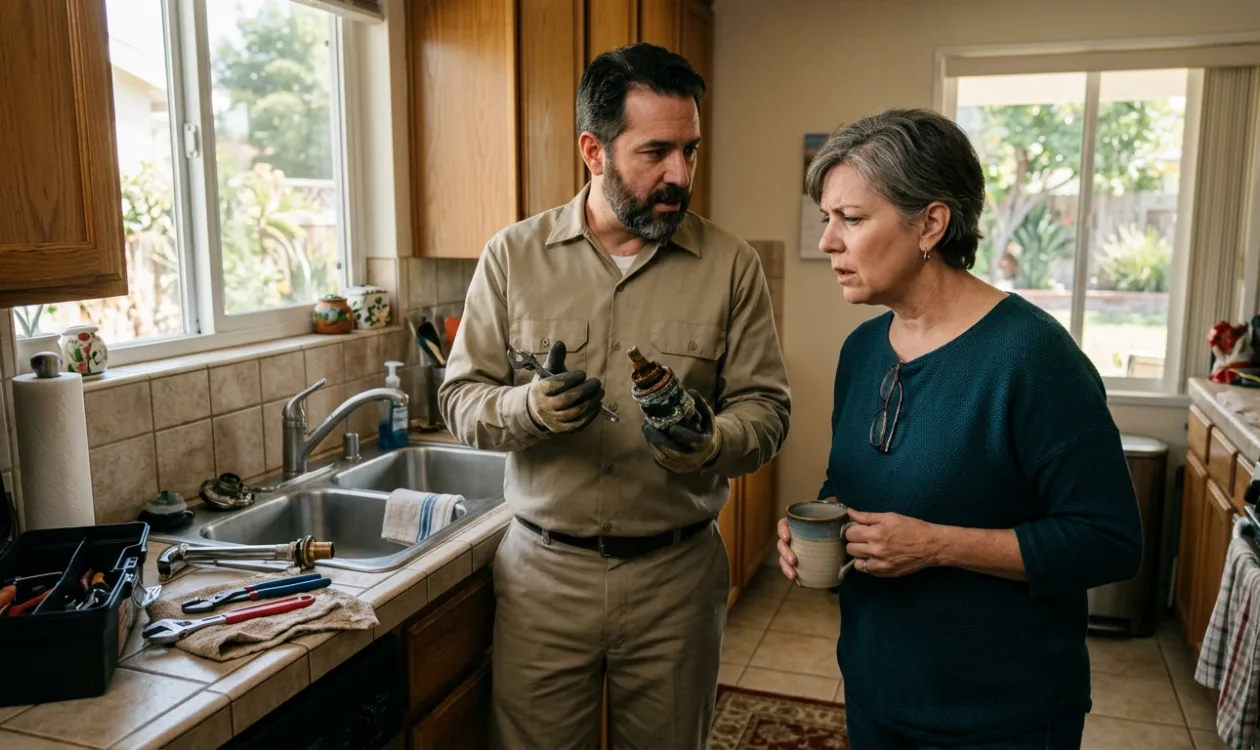
Strong candidates. A clay lateral with root intrusion at several joints but sound pipe between them (the most common finding under the city's older tree-lined streets) is close to the ideal lining job. So is cast iron that has corroded and cracked but retained its shape. Lines running under a driveway, a patio, a mature tree or established hardscape are where the economics tilt hardest toward trenchless, and in West Garden Grove, where longer laterals cross deeper front yards, the length saved from trenching is substantial.
Poor candidates. A collapsed section cannot be lined, because there is no host pipe left to line. A belly cannot be corrected by lining, the liner follows the sag faithfully and you keep the standing water. Severe joint offsets, where two sections have shifted vertically past each other, either prevent installation or produce a liner with a permanent ledge in it. Badly deteriorated Orangeburg is usually a bursting or open-cut candidate rather than a lining one. And where the failure is a single defect in an accessible stretch of lawn, a spot repair is simply cheaper and there is no reason to line the whole run.
The condo and townhouse case. In shared-wall buildings, laterals and building drains are often common elements the association maintains, and access frequently crosses shared ground. Trenchless work is attractive there precisely because it minimizes disruption to common areas and parking, but scheduling and approvals go through the association. Getting camera documentation in front of the property manager early tends to move things faster than a quote alone.
Length of the run, depth of the line, how many access pits are needed and where they can go, the condition of the host pipe and how much cleaning it takes, and whether the pits land in soil, lawn or concrete. Bursting generally costs more than lining on the same run because it moves more material and needs larger pits at both ends. Against all of that, subtract the restoration you are not paying for, and that is the comparison worth making, rather than plumbing line item against plumbing line item.
Minimize drain use: no laundry, no dishwasher, staggered flushing, short showers. If waste is already surfacing, stop using water entirely. Do not pour caustic drain chemicals into a line that a crew is about to work in. And gather up any previous clearing invoices, the dates establish how fast the pipe has been deteriorating, which sharpens the scope.
Trenchless questions
The honest answer to most of them starts with the camera footage.
Not always on the plumbing itself, and sometimes the trenchless line item is higher. The saving is in restoration. If the line runs under lawn that is easy to put back, open-cut often wins on total cost. If it runs under a stamped concrete driveway, established landscaping or a mature tree, trenchless usually wins comfortably once you count what replacing the surface would cost.
Cured-in-place liners are engineered for a design life in the range of fifty years, comparable to new pipe, and because the finished product is jointless there is nothing for roots to enter. Manufacturers publish their own figures and the installing contractor should tell you what warranty covers the work they performed.
No, and that is the most important thing to understand before anyone quotes it. Lining needs a host pipe that still holds its shape, without collapse, severe offsets or a belly. The camera survey is what establishes candidacy. A contractor who commits to lining before inspecting the line is guessing.
Slightly. The liner takes up some wall thickness, so internal diameter drops a little. On a standard residential four-inch lateral that reduction has no practical effect on flow, because the smooth jointless interior carries water more efficiently than rough old pipe at full bore did.
Typically one or two compact access pits rather than a trench along the line. Lining can sometimes be done from an existing cleanout plus a single pit. Bursting needs a pit at each end, and they are larger, because pipe has to be fed in and the head pulled through.
It depends where the defect sits and where your lateral ties into the city system. Work in the public right of way brings city requirements and sometimes separate permitting. One of the reasons trenchless is attractive here is that it can often reach a defect near the property line from a pit on your side of it.
Usually a day, sometimes two on longer runs or where the host pipe needs heavy cleaning. Your water supply is unaffected (this is the drain side), but you will need to plan around not using toilets, showers or laundry while the line is open and curing. The crew will give you a window.
Not properly. A belly is a loss of fall, and a liner installed through it reproduces the sag, so you keep the standing water and the sediment that collects in it. Correcting a belly means excavating that section and re-bedding it at proper grade. A camera survey will identify one clearly.
Both ends matter and both should be addressed in the scope. Lining is terminated and sealed at each end, and any branch connections along the run (a laundry tie-in, for example) have to be accounted for and reinstated. Ask specifically how branches are handled, because a liner installed over one without reopening it causes an obvious problem.
Sewer replacement and rehabilitation generally require a City of Garden Grove permit and inspection, whether the method is trenchless or open-cut. The contractor files it and schedules the inspection as part of the job, and you should expect to see it in the quote rather than discover it afterwards.
Cost comparison
Length, depth, access points and the condition of the host pipe set the number.
Get a Trenchless QuoteRelated work
The survey that decides whether your line can be lined at all.
Read moreSpot repair and open-cut replacement, and when each beats trenchless.
Read moreThe cleaning step a liner depends on, and a stopgap for a marginal line.
Read moreWhere we do this work
Long laterals under deep front yards and wide driveways.
Mature trees and older hardscape near the civic core.
Established streets off Chapman Avenue.
Neighboring tract housing with similar frontage.
Garden Grove & northwest Orange County
Stamped concrete and forty-year-old landscaping are expensive to put back.
Want to Keep Your Hardscape?