Water heater installation
The conventional tank option, and when it is genuinely the better value.
Read more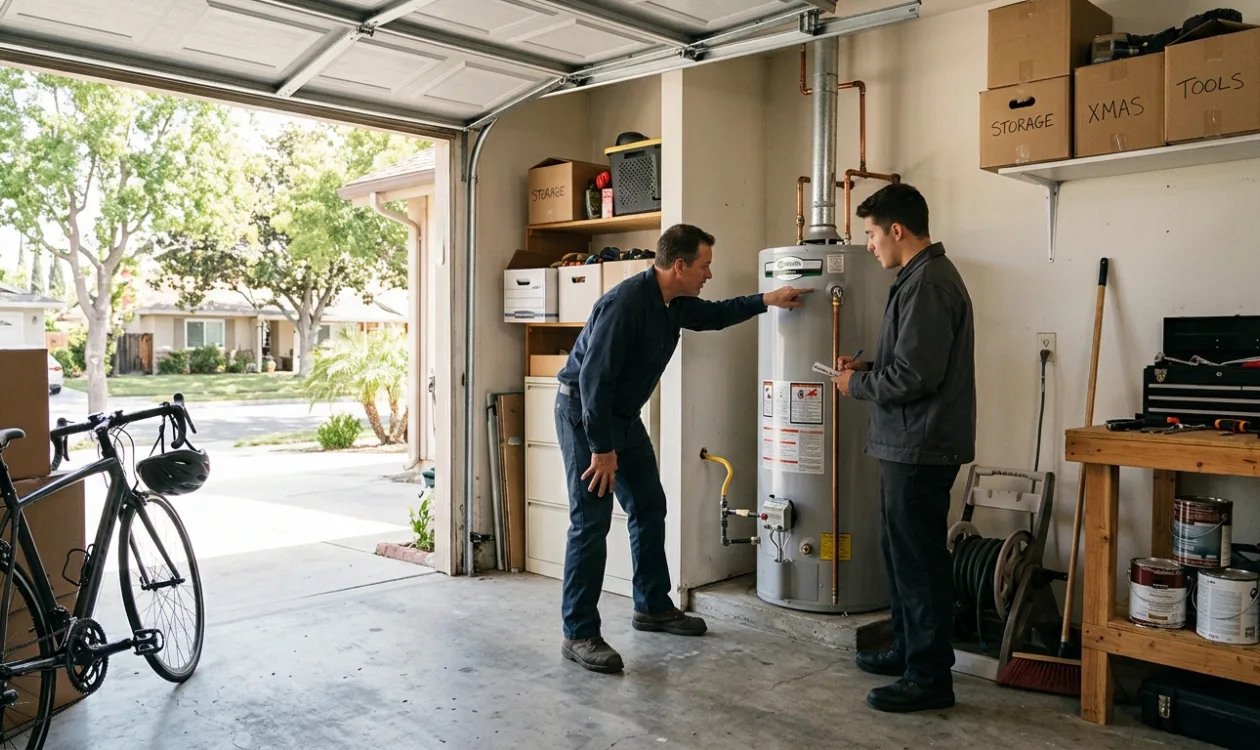
Endless hot water, with conditions
A tankless unit heats water as it flows, so it never runs out and it takes up a fraction of the space. The honest caveats are gas supply, venting and the annual descaling that hard local water makes non-negotiable.
Tell us where the current heater is and how many bathrooms it serves.
Call (657) 354-1942 About Going TanklessA tankless water heater has no storage. When a hot tap opens, a flow sensor fires a burner and water is heated as it passes through a heat exchanger. Close the tap and the burner stops. There is no reservoir being kept hot around the clock, and no reservoir to run out.
That produces the two headline benefits. Hot water is effectively unlimited (a long shower does not deplete anything), and standing heat loss disappears, which is where the efficiency gain comes from. The unit itself is roughly the size of a carry-on suitcase and hangs on a wall, freeing the floor space a tank occupied.
It also produces the requirements that make retrofits more involved than a like-for-like tank swap.
This is the usual gate. Heating water instantaneously requires a much higher burner input than a storage tank needs, because a tank has hours to recover while a tankless unit has seconds. Typical residential tankless units call for substantially more gas than the half-inch line feeding an old tank can deliver. In practice that often means a larger line run from the meter, and sometimes a meter capacity conversation with the utility. It is entirely doable; it is also frequently the single largest cost in the project, and any quote issued without checking it is not a real quote.
Modern condensing tankless units cannot use the old atmospheric flue. They vent through sealed stainless or polypropylene, usually horizontally through a wall, and they produce acidic condensate that needs draining and often neutralizing. Where the existing heater is in the middle of a garage with a roof flue, a new vent path has to be created. Where it is against an exterior wall, the run is short and the job is simpler, which is why installation cost varies so much between houses that look similar.
This is the part that gets undersold, and it matters more here than in most places. A tankless heat exchanger has narrow passages, and imported Southern California water is hard. Scale accumulates in those passages, reducing output and eventually triggering error codes and failure. The mitigation is an annual descaling flush through isolation service valves, which should be installed with the unit, not omitted to save a few dollars. Households that skip it for several years in this water discover the consequence, and it is expensive.
Two practical quirks worth knowing before you buy. There is a short delay while the burner fires and the exchanger comes up to temperature, so hot water arrives slightly later at the tap than from a tank. And very low flows (a trickling bathroom faucet) may not trigger the burner at all on some units. Neither is a defect; both are worth understanding so they are not a surprise.
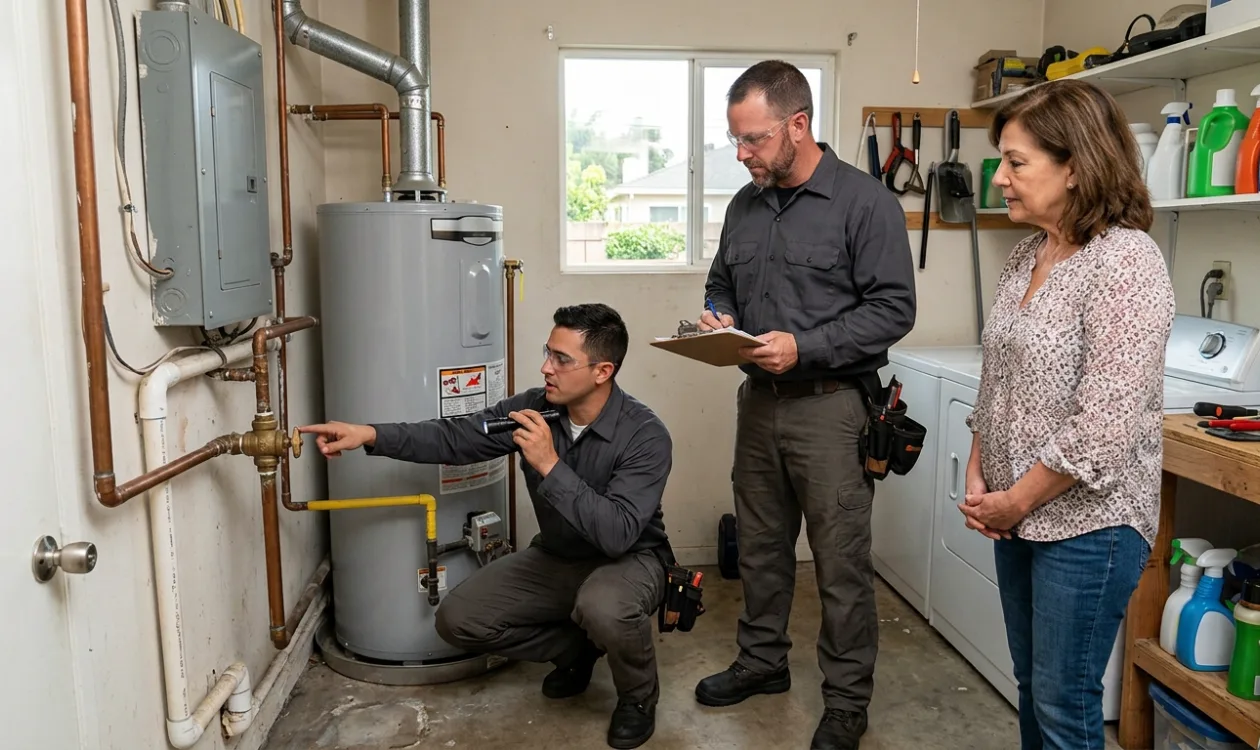
Before anything else, the existing gas line and meter capacity get assessed. That single check determines whether the project is straightforward or substantial.
Isolation valves for descaling should be part of the installation. Retrofitting them later means cutting into finished work.
Hard water makes this a yearly item, not a five-year one. Budget for it as part of ownership, like an oil change.
If you want instant hot water at a distant fixture, that is a recirculation system on top of the tankless unit, with its own cost and controls.
Gas line capacity is the gate on most retrofits, and it is checkable in one visit.
How the install runs
A retrofit is typically one to two days, and most of it is gas and vent work.
Get the Real Retrofit CostThe unit is rarely the biggest number. Gas and venting usually are.
Existing line size, meter capacity, appliance load and available vent routes measured, before a price is issued.
Sized on flow rate and temperature rise for your household, not on bathroom count alone. Condensing and non-condensing options explained.
Unit mounted, gas upgraded where required, sealed venting run, condensate drainage arranged, service valves and water connections fitted.
Gas pressure verified under load, temperature set, operation tested across fixtures, and an annual descaling interval agreed.
Local ground truth
Tight installations near the older core. In the early-1900s craftsman housing around Historic Main Street and the Village Green, water heaters often sit in cramped service porches or exterior closets where capacity is physically constrained. A wall-hung tankless unit removes that constraint entirely, and if the location is against an exterior wall the venting is straightforward. This is the situation where tankless most clearly earns its cost.
ADU conversions. Attached and detached accessory dwelling units are being added across the city, and they are new installations rather than replacements. Space is at a premium, gas and venting are being designed from scratch anyway, and a tankless unit avoids surrendering floor area in a small dwelling. Since the gas run is new regardless, the usual retrofit cost objection largely disappears.
Households that keep running out. Where a family of four or five is exhausting a forty-gallon tank every morning, the choice is a larger tank or a tankless unit. Both solve it. Tankless solves it without occupying more floor space, and in a garage with a workable vent path the arithmetic is often competitive.
Where a tank is usually still better. A spacious garage installation with a functioning atmospheric flue, a half-inch gas line and a household whose current heater keeps up fine is not a compelling tankless candidate. Replacing it with a good tank costs considerably less, works during a power cut, and does not require annual descaling. An honest recommendation sometimes is "keep the tank."
Condo and townhouse closets. Attractive in principle for the space saving, but tightly constrained in practice. Sealed venting has to find an exterior wall, condensate needs a drain, gas supply may be shared and limited, and association approval is usually required. It is worth investigating, but expect the feasibility question to take longer to answer than in a detached house.
Condensing units extract additional heat from exhaust gases, run at higher efficiency, and vent through inexpensive plastic, but they produce acidic condensate requiring drainage and often neutralization. Non-condensing units are cheaper to buy, vent through more expensive stainless, and run hotter exhaust with no condensate. For most local retrofits with a reachable exterior wall and a drain, condensing is the usual recommendation.
Gas line upgrade requirements first, and this is the big variable. Then venting complexity, a short horizontal run through an adjacent wall versus a long routed path. Then the unit itself and whether it is condensing. Then condensate handling. Then whether the existing electrical supply at the location is adequate, since these units need power for controls and ignition. Then the permit. And finally optional additions: a recirculation pump for faster delivery at distant fixtures, or a softener to protect the exchanger, both of which are worth pricing at the same time rather than later.
Tankless questions
The gas line question comes first, and the descaling question comes second.
In normal use, no it will not, it heats continuously as water flows. The real limit is simultaneous demand: a unit has a maximum flow rate at a given temperature rise, so running two showers and a dishwasher at once can exceed it and you will notice cooler water. That is a sizing question, which is why a proper installer calculates flow and temperature rise rather than going by bathroom count.
Very often, yes, and it is the main reason retrofit quotes vary so widely. Tankless units need far more gas input than a storage tank because they heat instantaneously. The existing half-inch line that fed an old tank is frequently inadequate, which means a larger run from the meter and sometimes a conversation with the utility about meter capacity. Any quote issued without checking this is not reliable.
Generally not. Condensing tankless units require sealed venting in stainless or polypropylene, usually run horizontally through an exterior wall, and they produce condensate that needs draining. An old atmospheric flue serving a storage tank cannot be reused. Where the heater location is against an outside wall this is simple; where it is in the middle of a garage it means creating a new vent path.
Plan on annually. Local water is hard, and a tankless heat exchanger has narrow passages where scale accumulates quickly, reducing output and eventually causing faults. Descaling is a flush through isolation valves, which is exactly why those valves should be installed with the unit. Skipping it for years in this water leads to expensive repairs.
Often not, and an honest assessment will say so. If you have a spacious garage installation with adequate venting and a tank that keeps up with demand, replacing it with another good tank costs much less. Tankless earns its cost where space is tight, where demand exceeds what a tank can supply, where you are installing new anyway, or where you specifically want the efficiency and endless supply.
The burner has to fire and bring the heat exchanger up to temperature when flow starts, so there is a short lag on top of the normal time water takes to travel the pipe. It is inherent to the technology rather than a fault. If instant delivery at a distant fixture matters to you, that is solved with a recirculation system, which is a separate addition with its own cost.
No. Tankless units need electricity for controls, ignition and the flow sensor, so a power cut means no hot water even though the gas supply is unaffected. A conventional atmospheric gas tank keeps supplying stored hot water through an outage. For some households that is a genuine consideration.
Longer than tanks when maintained, heat exchangers are serviceable components and there is no lined steel tank waiting to corrode through. The condition is maintenance: an undescaled unit in hard water can fail well before a well-kept tank would. Treat the annual flush as part of the deal and the longevity advantage is real.
Yes, units can be manifolded together to serve high simultaneous demand, and it is a common approach in larger homes. It also multiplies the gas supply requirement, so the sizing and gas assessment become more important rather than less. For most homes in this city a single properly sized unit is sufficient.
Not strictly required, but in this water it is a reasonable pairing. Softening or filtration slows scale accumulation in the heat exchanger, extends the interval before performance drops, and protects fixtures, dishwashers and shower cartridges at the same time. It is worth pricing alongside the tankless installation rather than as an afterthought.
Cost drivers
In this water it is annual. Better to hear that now than in year three.
Ask About DescalingRelated work
The conventional tank option, and when it is genuinely the better value.
Read moreIf the existing unit is repairable, that may be the cheaper answer entirely.
Read moreScale protection for the heat exchanger and everything else in the house.
Read moreWhere we do this work
Tight service porches where a tank will not fit.
Older housing and infill near the core.
Mixed housing on the south side.
Neighboring city, same retrofit considerations.
Garden Grove & northwest Orange County
Endless supply is the real advantage, and the reason most people switch.
Running Out of Hot Water?