Toilet repair & installation
The other fixture in the room, and its own set of failures.
Read more
Showers · tubs · valves behind the tile
Most shower problems are one part behind the tile. A worn cartridge, a failed diverter, a scalding balance valve. We connect you with a local plumber who works out which, and opens as little wall as the job genuinely needs.
Dripping, no hot, weak flow, or water where it should not be, each one points somewhere different.
Call (657) 354-1942 About a ShowerEvery shower complaint eventually leads to the same place: the mixing valve buried in the wall. Everything you can see (the handle, the escutcheon plate, the head, the tub spout) is trim. The valve is the part that actually does the work, and it is the part that wears out. Understanding that changes how you think about the repair, because trim is easy and the valve is where the cost lives.
The good news is that most valves do not need replacing. They need a cartridge. A cartridge is a serviceable insert, and on any mainstream brand it can be pulled out through the front of the wall without opening tile. A dripping shower, a handle that has become stiff, a temperature that has crept, those are almost always cartridge symptoms, and they are a modest repair done from the bathroom side.
The bad news is what happens when a valve body itself has failed, or when the brand is obsolete and no cartridge exists. Then the valve comes out, and that means access, either from behind, through a closet or an adjoining wall, or from the front through the tile. A competent plumber looks for a back-side access route before touching the tile, because the difference in cost and disruption is significant.
A shower head that drips after the handle is off is not a head problem. Water is passing the valve seal. On a cartridge valve it is the cartridge; on an old two-handle compression valve it is the seat washers and possibly the seats themselves. Neither is expensive. Both waste a genuinely large amount of water if ignored, and in a hard-water city like this one the drip also leaves mineral tracks down the tile.
In a tub-shower combination, the diverter sends water up to the head instead of out the spout. When it fails you get water coming out of both at once, and neither with any force. If the diverter is in the tub spout, the fix is a new spout, simple. If it is a third handle or built into the valve, it is a cartridge or a valve repair. Which one you have is visible from the wall, and worth mentioning on the phone.
A shower that turns hot when a toilet flushes has no pressure-balancing valve, or has one that has failed. Modern valves are required to be pressure-balanced or thermostatic precisely for that reason, and retrofitting one into an older bathroom is one of the most worthwhile upgrades in the whole house, particularly with children or older adults using the shower. A valve whose maximum temperature has drifted can also usually be re-limited at the cartridge, which costs almost nothing.
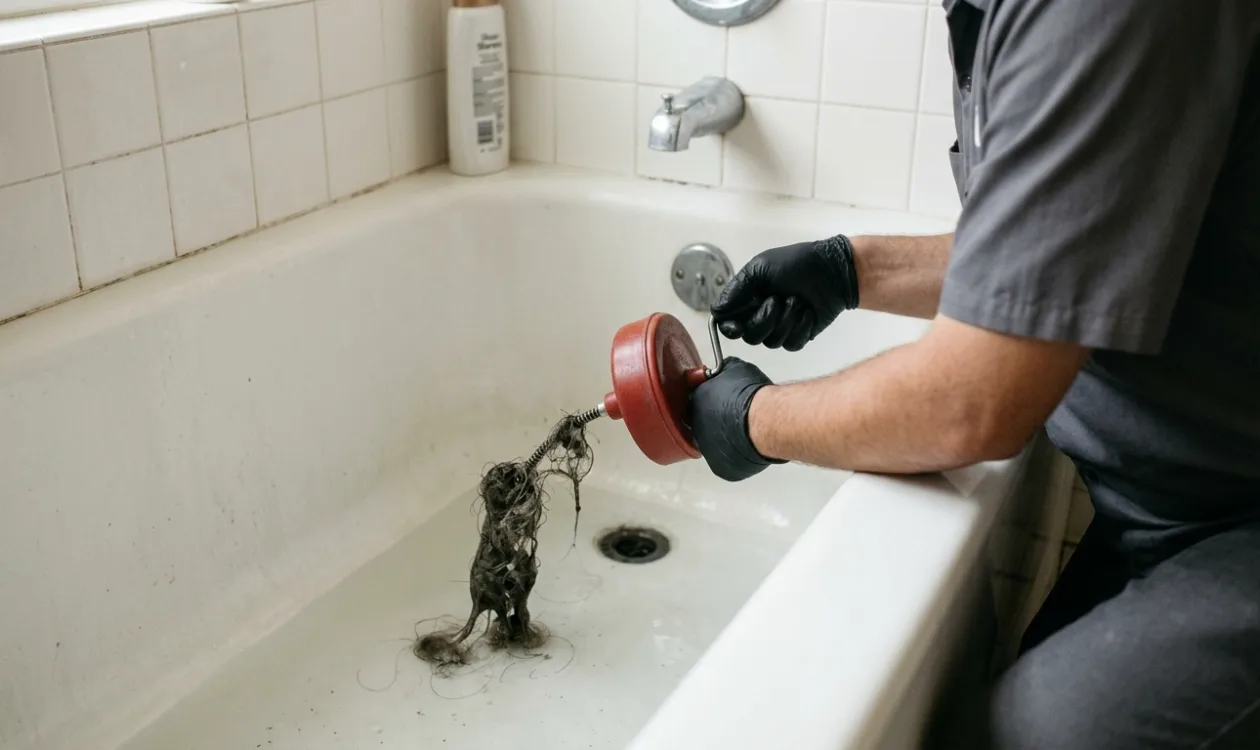
A tub that drains slowly is usually hair and soap in the shoe fitting or the trap, and it clears mechanically. A tub that leaks into the room below is a different matter, and the culprit is far more often the overflow gasket or the shoe gasket than the tub itself. Both live under the tub, and getting to them means access from below on a raised-foundation house or through an adjacent wall on a slab. Diagnosing which gasket is passing water before opening anything is what separates a tidy repair from a big one.
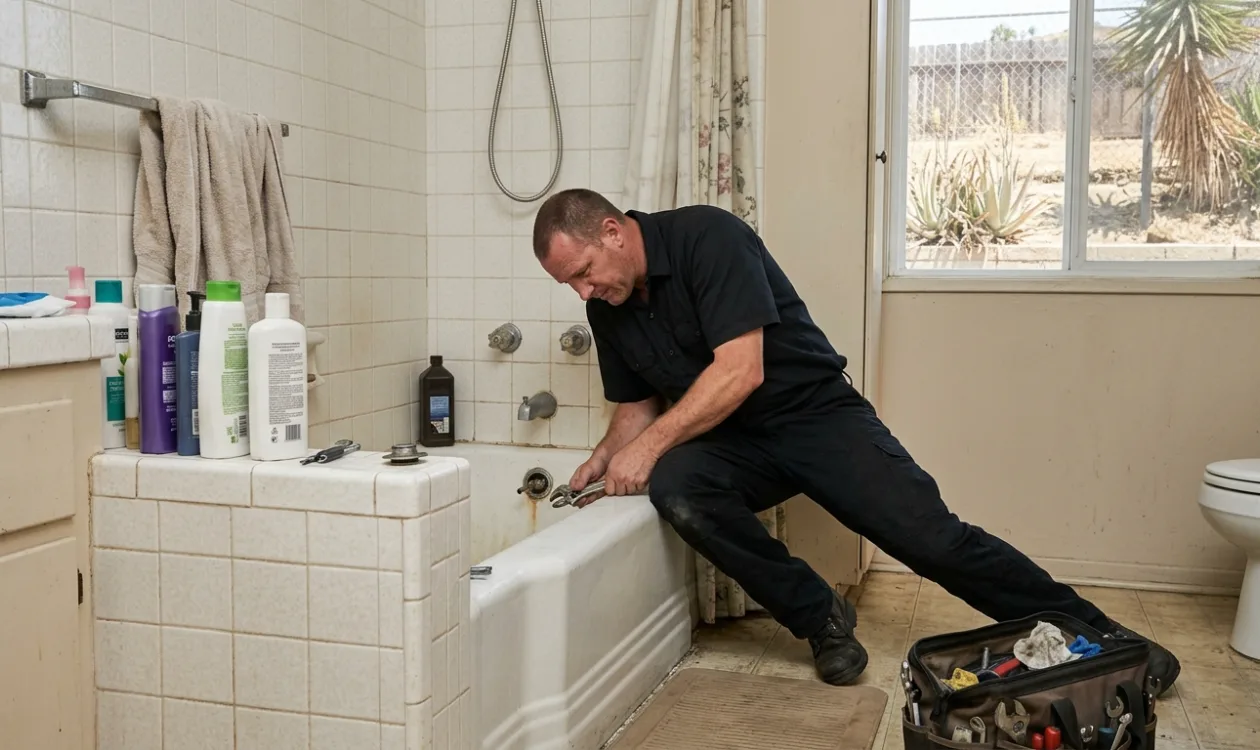
The handle or the plate usually carries a maker's mark. Knowing the brand tells the plumber whether a cartridge is available before the visit.
If there is a closet, hallway or garage wall directly behind your shower valve, say so. Working from that side can save the tile entirely.
If your shower goes hot when a toilet flushes, a pressure-balancing valve fixes it permanently. It is the single best safety upgrade in an older bathroom.
Nine out of ten shower complaints are the valve cartridge, not the plumbing behind it.
How the visit goes
The order of operations exists to keep tile intact. Nobody cuts anything until the diagnosis is certain and you have approved the price.
Walk Us Through the BathroomTub, shower or combination, single handle or two, and roughly what era the bathroom is. That is enough to start.
What the shower is doing, and what valve is in the wall. Brand and type decide whether a cartridge is even available.
Cartridge, seats, seals and trim are all serviceable through the wall face. Most jobs end here.
If the valve body must come out, the plumber looks for a back-side opening before considering tile.
Both temperatures, full flow, diverter operation, and no drip after shut-off. Access neatly patched or a panel fitted.
Local specifics
You can usually guess a Garden Grove bathroom's plumbing from the year the house went up. The late-fifties and sixties tracts (the bulk of the city) came with two-handle compression valves and cast-iron tubs, often with galvanized supply. Those bathrooms are the ones where handles have gone stiff and hot water has become a negotiation. A single-handle pressure-balanced valve retrofit transforms them, and because the tile in those houses is frequently the original four-inch square, plumbers work hard to find an access route that does not touch it.
The seventies and eighties condo and townhouse stock brought fiberglass surrounds and single-handle valves, many now on their second or third cartridge. Those are the easiest repairs in the city: the valve is accessible, the parts are available, and the work is done from the front in an hour.
Then there is the current wave of bathroom remodels and ADU builds. New valves, new supply, and a completely different failure profile, when something goes wrong there it is usually an installation detail rather than wear. A shower arm that was not sealed properly, a valve set too deep for its trim, a mixing valve installed backwards. Those are diagnosed differently and fixed quickly.
Orange County water is hard enough that scale is a genuine maintenance factor in a shower. It blocks the small ports in a shower head, it builds on cartridge seals so the handle stiffens, and it deposits on the valve seat so the shut-off stops being clean. A shower that has become gradually weaker over years usually has a head full of deposit, which is a five-minute clean, not a plumbing job. If descaling the head does not restore it, then the plumber looks at the valve and the supply.
Most of Garden Grove sits on slab-on-grade, which changes tub-leak work considerably. There is no crawlspace to reach the tub shoe and overflow from below, so access comes through an adjacent wall or the tub apron. That is exactly why the diagnosis has to be right first: distinguishing a splash leak past bad caulk from an overflow gasket leak from a genuine drain-line problem determines whether anything needs opening at all.
Tub-to-shower conversions are a common request in the older neighborhoods as households age in place. The plumbing side is a drain relocation from a tub shoe to a shower drain, a new pan or base, and usually a new valve at a comfortable height. If you are considering one, that conversation is worth having before any tile comes off, because the drain position drives everything else.
Shower and tub questions
Where the cost lives, what can be fixed without cutting tile, and what cannot.
Usually not. Water passing after shut-off means the valve seal is worn, a cartridge on a single-handle valve, or seat washers on an old two-handle set. Both are done from the front of the wall.
It is worth fixing promptly. A steady drip wastes a real amount of water and stains hard-water tile.
Often not. Cartridges, seals, seats and all the trim come out through the front of the wall. That covers the large majority of shower repairs.
Tile only comes into it when the valve body itself has to be replaced, and even then the plumber looks for access from a closet, hallway or garage wall behind the shower first.
Yes, and it should be. That happens when there is no pressure-balancing valve, so a drop in cold pressure lets hot dominate. Modern pressure-balanced or thermostatic valves prevent it.
Retrofitting one is the most worthwhile safety upgrade in an older bathroom, especially with children or older adults in the house.
The diverter has failed. If it is the pull-up knob on the tub spout, a new spout fixes it. If it is a separate handle or built into the valve, it is a cartridge or valve repair.
Look at your wall and tell us which arrangement you have, it changes the parts entirely.
Clean the shower head first. Hard-water scale blocks the outlet ports gradually, and a soak plus a brush restores most heads completely.
If the head is clear and it is still weak, and other fixtures are fine, the valve is restricted. If everything in the house is weak, the issue is pressure or supply pipe.
Typically under an hour, assuming the cartridge for that brand is available and the valve is not seized in place. A long-seized cartridge in a hard-water house occasionally needs a puller and more patience.
You are told the likely time and cost before work starts.
Possibly, but the tub itself is rarely the culprit. The usual sources are the overflow gasket, the drain shoe gasket, the valve behind the wall, or water getting past failed caulk at the tile line.
Those get tested separately (filling and draining, running the shower without splashing, running the valve only), so the right thing gets opened, once.
Yes, and it is a common upgrade in the older tracts. It means a new valve body, which means access, and the trim plate on a conversion often covers the old openings.
The plumber will show you what the finished wall will look like before starting, because that is the part people care about most.
No. A slow tub on its own is almost always hair and soap in the shoe or trap, and it clears mechanically in a short visit.
If the tub, the toilet and the sink are all slow together, that is a main line issue and a completely different job.
The plumbing side, yes: relocating the drain from a tub shoe to a shower drain, setting a base, and fitting a new valve at a usable height.
That work is best scoped with the tile off, so call (657) 354-1942 early in your planning rather than after demolition.
Pricing
Cartridge, trim, access if needed, and the tile put back thoughtfully, quoted before anyone cuts.
Ask What Valve Work RunsRelated work
The other fixture in the room, and its own set of failures.
Read moreWhen the shower has no hot water but the valve is fine.
Read moreSlow tubs, slow sinks and everything downstream of them.
Read moreWhere we do this work
Original tile and two-handle valves.
Sixties tracts with cast-iron tubs.
Condo and townhouse valve retrofits.
Nearby, same bathroom vintages.
Garden Grove & northwest Orange County
A dripping shower wastes water every hour it runs. Most valve work is a single visit.
Fix the Shower This Week