Drain cleaning
When the blockage is past the fixture and other drains are slow too.
Read more
Toilets · repair, rebuild or replace
A toilet that runs all night, rocks when you sit down or needs two flushes is telling you something specific. We connect you with a local plumber who reads the symptom, quotes the fix, and does not sell you a new bowl you do not need.
Tell us whether it runs, leaks at the base or will not clear, each one points somewhere different.
Call (657) 354-1942 About a ToiletNearly every toilet call in Garden Grove comes down to one of four things, and they are easy to tell apart once you know what to listen for. A toilet that hisses or refills on its own every twenty minutes is a tank problem, the flapper is no longer sealing, or the fill valve is letting by. A toilet that leaves a ring of water at the base is a seal problem, and the wax ring underneath has failed or the flange it bolts to has cracked. A toilet that needs a second flush is a volume or a drainage problem. And a toilet that rocks is a mounting problem, which becomes a seal problem if it is left alone.
The distinction matters because the cost range is enormous. A flapper is a few dollars and ten minutes. A cracked closet flange under a tiled floor is an hour of careful work and a repair collar. Both look, to a homeowner standing in the doorway, like “the toilet is broken.” The point of the phone call is to sort out which one you have before anybody quotes anything.
A flapper that seals imperfectly does not announce itself. The tank drips down past the seal, the water level drops, the fill valve tops it back up, and the cycle repeats all night. There is no puddle and no noise you would notice over the air conditioning. What there is, is a water bill that climbs by a third. Garden Grove homeowners usually spot it on the bill rather than in the bathroom.
The test costs nothing: put a few drops of food coloring in the tank, leave it an hour without flushing, and look in the bowl. Color in the bowl means the flapper is passing water. That single check is the difference between a part swap and a mystery.
A wax ring compresses once, when the toilet is set. It does not recover. If the bowl has been rocking on an uneven floor, or if the toilet was reset after flooring work without a new ring, that seal breaks down and waste water tracks out under the base. What you see is a damp edge or a dark line in the grout. What is happening under the tile is worse, and on a slab-on-grade house the damage stays hidden until the smell arrives.
The repair is a pull-and-reset: lift the bowl, inspect the flange, replace the ring, replace the closet bolts, shim and re-level, and re-caulk. If the cast-iron flange has rusted out (common in Garden Grove houses built before 1965), a repair flange goes on first. That extra step is the most frequent surprise on a toilet job, which is why the plumber checks for it before quoting rather than after.
Before condemning a bowl, the pro checks three things: the tank water level, the rim jets, and the line downstream. A tank filling an inch low loses flush energy. Rim jets blocked with mineral scale send water down the sides instead of around the bowl, Orange County water leaves that deposit steadily. And a partially blocked branch line makes a perfectly good toilet look tired. Only after those three come back clean does replacing the fixture become the honest answer.
The exception is the genuine first-generation low-flow toilets installed in the early nineties. Those units were 1.6 gallons with the trapway geometry of a 3.5-gallon design, and they flush poorly no matter what you do to them. If you have one, replacement is not an upsell, it is the fix.
A swap is a contained job: shut the angle stop, drain and disconnect, remove and haul the old unit, prep the flange, set the new bowl on a fresh ring, bolt and level, connect a new braided supply line, and test through several cycles. Most take about two hours. Where it stretches is old cast-iron flanges, angle stops that have seized after thirty years of never being turned, and tile that has been laid up against the base so the old unit has to be cut free carefully.
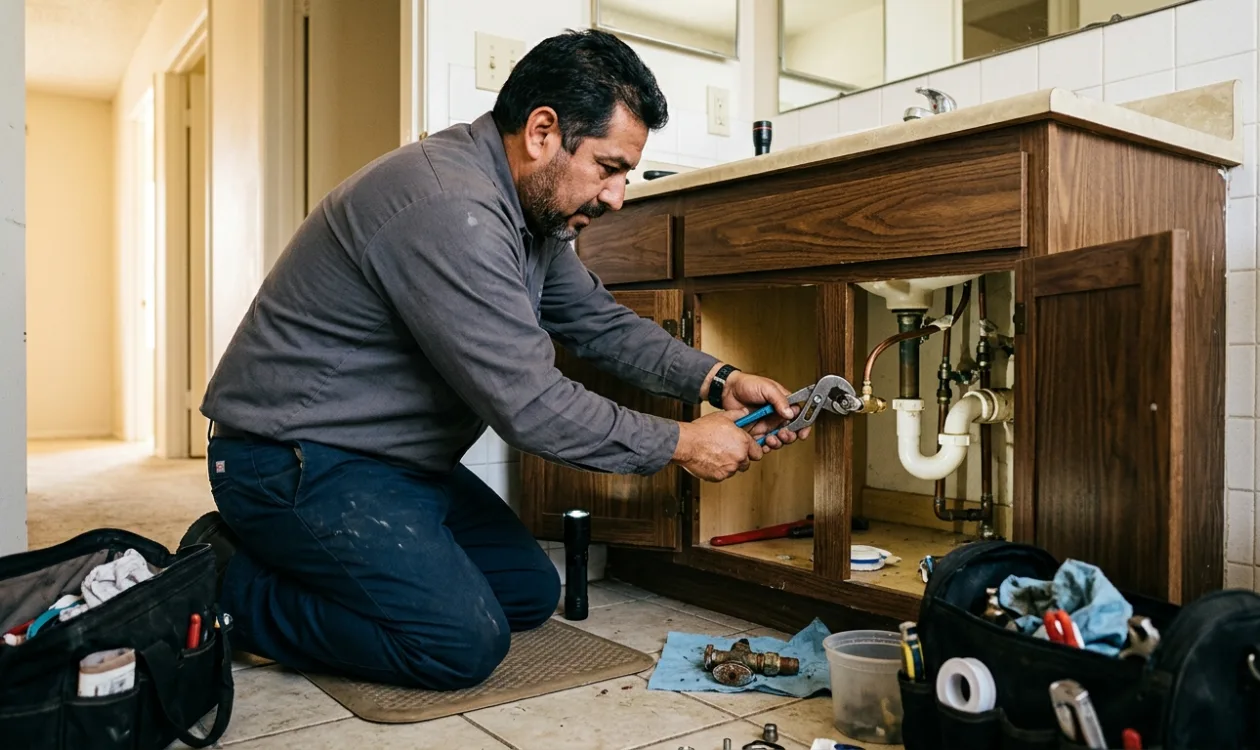
Food coloring in the tank, an hour with no flushing, then look in the bowl. Color there means the flapper is leaking.
Measure the rough-in: the distance from the wall to the closet bolts. Ten, twelve and fourteen inches are all out there, and a twelve-inch toilet will not sit on a ten-inch rough-in.
A rocking toilet is not cosmetic. Every movement works the wax seal, and a failed seal on a slab house means water going somewhere you cannot see.
Water on the floor and water in the bowl are two completely different repairs.
How the visit goes
No mystery, no leaving you guessing what happens next. Four steps, and a price you approve before anybody touches the fixture.
Talk Through the SymptomsTwo minutes on the phone usually tells us whether this is a ten-dollar part or a replacement.
Running, leaking, weak, rocking, or blocked. That single sentence decides whether this is a part, a reset or a replacement.
Tank internals, water level, flange condition and downstream flow all get checked before anything is quoted.
You hear one number covering parts and labor. If a repair flange or a new angle stop is needed, that is in the number, not added later.
Several full flush cycles, a check around the base with a dry cloth, and the old unit hauled away.
Local specifics
The housing stock here tells you what to expect before you walk in. The big tract build-outs of the late fifties and sixties (the streets north of Chapman and the grid off Magnolia) came with cast-iron closet flanges and 3.5-gallon toilets. Many of those flanges are now sixty-plus years old and rusted at the bolt slots. When one of those houses calls about a wobbling toilet, the flange is the first thing the plumber looks for, because it changes the job.
The nineties infill and the condo conversions came with the first-generation low-flow units. Those are the double-flush complaints. And the recent ADU and garage-conversion work across the city has produced a third category entirely: brand-new toilets on brand-new drain lines, where any problem is almost always a venting or a slope issue in the new plumbing rather than the fixture itself.
Water chemistry is the constant. Orange County supply carries enough hardness to build visible scale, and toilets show it in two places: the rim jets, where deposits redirect the flush, and the fill-valve seat, where scale keeps the valve from closing cleanly. A toilet that has never been descaled in fifteen years flushes measurably worse than the same model kept clear. It is a real and fixable cause, and it gets checked before anyone suggests a new bowl.
Two-story homes near Village Green and the newer developments put a toilet over living space. A base leak there is not a floor stain, it is a ceiling stain in the room below, and by the time it shows, the subfloor has been wet for a while. Upstairs toilets get a closer look at the flange and the seal, and the plumber checks the ceiling below before and after the reset.
Bidet seats are common in this part of the city, and they change the plumbing at the toilet. Most need a cold-water tee at the fill line and, if they are heated, a nearby outlet. A tee installed on a brittle old angle stop is a leak waiting to happen, so the angle stop usually gets replaced at the same time. If you are having a seat fitted, mention it on the call, the parts needed are different.
Toilet questions
The questions that come up on nearly every toilet call, answered plainly.
Usually not. Intermittent refilling almost always means the flapper is no longer sealing or the fill valve is passing water. Both are inexpensive parts and quick work.
What is not cheap is leaving it. A slow-passing flapper can add a meaningful amount to a monthly water bill, and it does it silently.
It means the seal between the toilet and the drain has failed, or the flange it bolts to is damaged. The repair is to lift the toilet, inspect the flange, and reset it on a new wax ring with new bolts.
Do not seal around the base with caulk to hide it. That traps the water under the fixture and hides the damage while it continues.
Not necessarily. Low tank water level, scaled-over rim jets and a partial blockage downstream all cause weak flushing in a perfectly sound toilet. Those get checked first.
The genuine exception is an early-nineties 1.6-gallon unit. Those flush poorly by design, and replacement is the real answer.
A straightforward swap is about two hours including haul-away. That covers shutting the water, removing the old unit, prepping the flange, setting the new bowl, connecting a new supply line and testing.
It stretches when the closet flange is corroded, the angle stop is seized, or tile has been laid tight against the old base.
The rough-in is the distance from the finished wall to the center of the closet bolts, commonly twelve inches, but ten and fourteen exist too. It determines which toilets will physically fit.
If you are buying your own fixture, measure this first. It is the single most common reason a new toilet has to go back to the store.
Yes. Bring the box, keep the paperwork, and have it on site for the visit. The plumber checks the rough-in and the trapway before starting so there are no surprises halfway through.
You are quoted for the installation labor and any parts the box does not include, a wax ring, closet bolts and a supply line are often not in it.
Tightening a rocking toilet onto an uneven floor is how bowls crack. The gap needs shimming and the bolts brought up evenly, and if the toilet has been rocking for a while the wax seal has already been compromised.
The correct fix is a pull, a new ring, proper shims and a re-level.
Yes, in practice. Two-piece toilets have a tank-to-bowl gasket and separate bolts, which is one more place to leak but easier and cheaper to service. One-piece units are simpler to clean and have fewer seals, but a cracked one is a whole-fixture replacement.
Neither is a wrong choice. The plumber can tell you what fits your space and your budget.
Yes. A blockage in the toilet trap itself is cleared with a closet auger. If the blockage is past the fixture and other drains are slow too, that is a branch or main line issue and a different tool set entirely, see our drain cleaning page.
It depends entirely on which of the four problems you have, and the plumber quotes it after looking. What does not change is the order: diagnosis first, price second, work third.
Call (657) 354-1942 and describe the symptom. You will get a realistic range on the phone and a firm number on site.
Pricing
Bowl, wax ring, supply line, closet bolts, haul-away of the old unit, quoted as one number before anyone starts.
Ask What a Swap CostsRelated work
When the blockage is past the fixture and other drains are slow too.
Read moreValves, diverters, tub spouts and the plumbing behind the tile.
Read moreSinks, tubs, laundry and outdoor spigots, same visit, often.
Read moreWhere we do this work
Pre-1960 homes with original cast-iron flanges.
Big tract build-outs, plenty of original fixtures.
Two-story homes with upstairs bathrooms.
Neighboring city, same-day toilet calls.
Garden Grove & northwest Orange County
One working bathroom in the house is a real problem. Most toilet calls are same-day work.
Have a Toilet Sorted Today