Leak detection
Acoustic, thermal and pressure testing to pin a leak before anything gets cut open.
Read more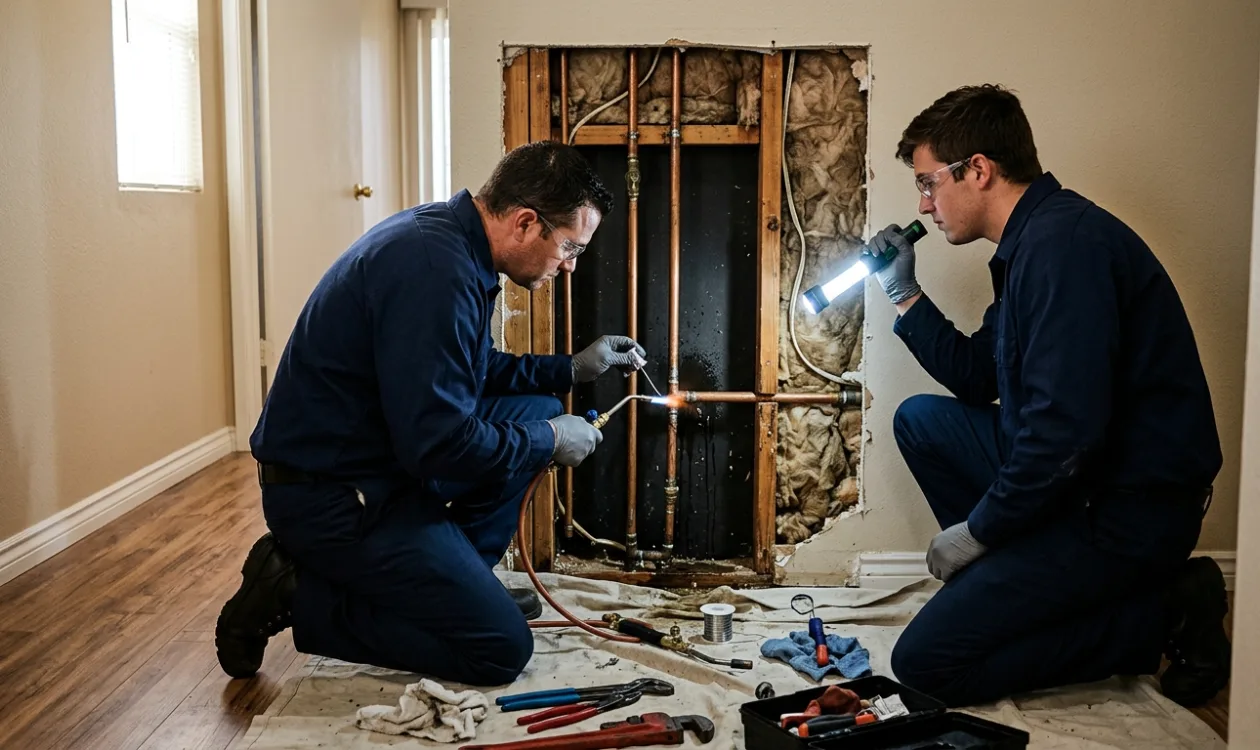
Pressurized line failures
A supply line under pressure does not drip when it fails: it pumps. Close the main, then call, and a local pro will isolate the break, find where the water actually traveled, and repair the pipe rather than patch the symptom.
Main already off? Good. Now let us get someone routed to you.
Call (657) 354-1942 About a Burst LineA burst pipe is a pressurized supply line that has lost its wall integrity. Unlike a drain, which only carries water when something upstream is running, a supply line is under constant pressure, typically 50 to 80 psi in a healthy Garden Grove home, and considerably more where a pressure regulator has failed. That means a failure the size of a pinhole releases water continuously, twenty-four hours a day, until someone closes a valve.
The word "burst" covers several different failures, and telling them apart determines whether you are buying a repair or a repipe.
The classic Southern California version. Copper thins from the inside out, accelerated by water chemistry and by velocity at elbows and tees. What you get is a needle-fine jet, sometimes audible as a faint hiss before anything is visible. The critical question is whether it is a one-off at a stress point or the first of many: when a plumber cuts out a section and the wall thickness is uniformly reduced along it, the rest of the system is on the same clock.
Freezing is rare here, but not unheard of on an exposed exterior run or an uninsulated attic line during a cold snap. Impact damage is more common than people expect, a nail or screw driven into a stud bay during a remodel, a picture hanger, a garage shelf anchor. Those failures are usually a clean longitudinal split and a genuinely simple repair once located.
In the older housing near Historic Main Street and the Village Green, original galvanized supply lines corrode from the threads outward. The failure appears at a joint, and the metal for several inches either side is often too thin and too brittle to hold a new fitting. This is the failure mode most likely to end with a recommendation to repipe rather than repair, because each successful repair puts pressure on the next weakest joint.
Newer construction and past repipes bring their own version: a crimp ring that was never fully seated, a fitting stressed by a tight bend, or plastic that has gone brittle near a heat source. These are localized and repairable, but they raise a fair question about who did the original work and whether other joints share the defect.
Repairing the pipe is often the smaller half of the job. Water from a wall-cavity break runs along framing and shows up in unexpected places, a stain on a ceiling one room over, warped baseboard on the far side of a hallway, a swollen cabinet kickplate. A plumber who cuts drywall based on where the stain is, rather than where the moisture meter and the thermal camera say the water is, will open the wall more than once. Getting that right the first time is most of what you are paying for.
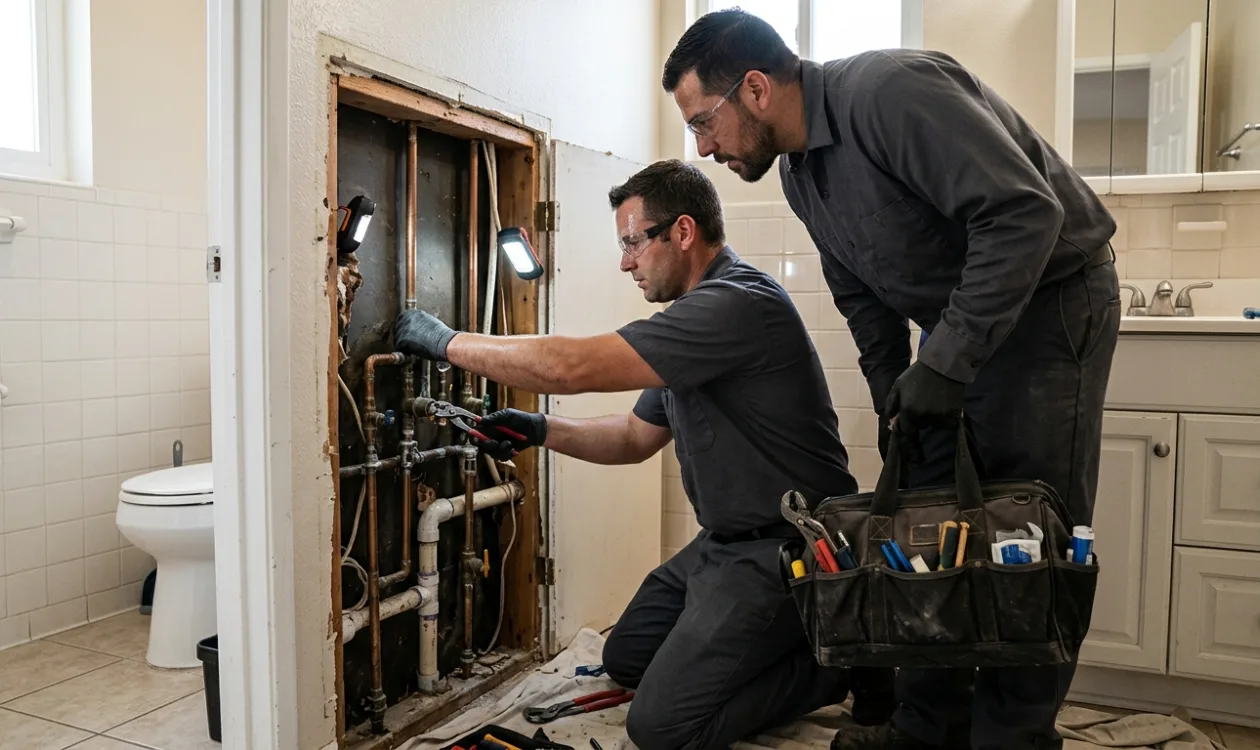
Close the main. Then open the lowest faucet in the house and an outside hose bib to drain the standing pressure out of the system, which stops the leak from continuing to feed off what is already in the pipes.
If water is anywhere near outlets, a panel or recessed lighting, shut those circuits off at the breaker before you go near the area.
A cavity that is still damp will grow mold behind new drywall. Repair, dry properly with air movement, then patch, in that order.
When the failed section comes out, ask the plumber what the pipe wall looked like. Uniform thinning is a repipe conversation; a clean split from a nail is not.
Copper, galvanized and PEX each fail differently, describe what you saw and we will match the pro.
How the repair runs
The order is not negotiable. Anyone opening drywall before the water is off is working backwards.
Have Someone Come LookThe pipe is one problem. Finding where the water went is the other.
Main closed, system drained down. If a branch can be isolated instead, the rest of the house keeps running.
Moisture meter, thermal camera and acoustic listening to pin the break, rather than cutting toward the stain and hoping.
The failed section is removed to sound pipe on both sides, then repaired in copper, PEX or a proper transition fitting where materials change.
The line is brought back up and watched under pressure before anything gets closed, and the cavity is dried before patching.
Local ground truth
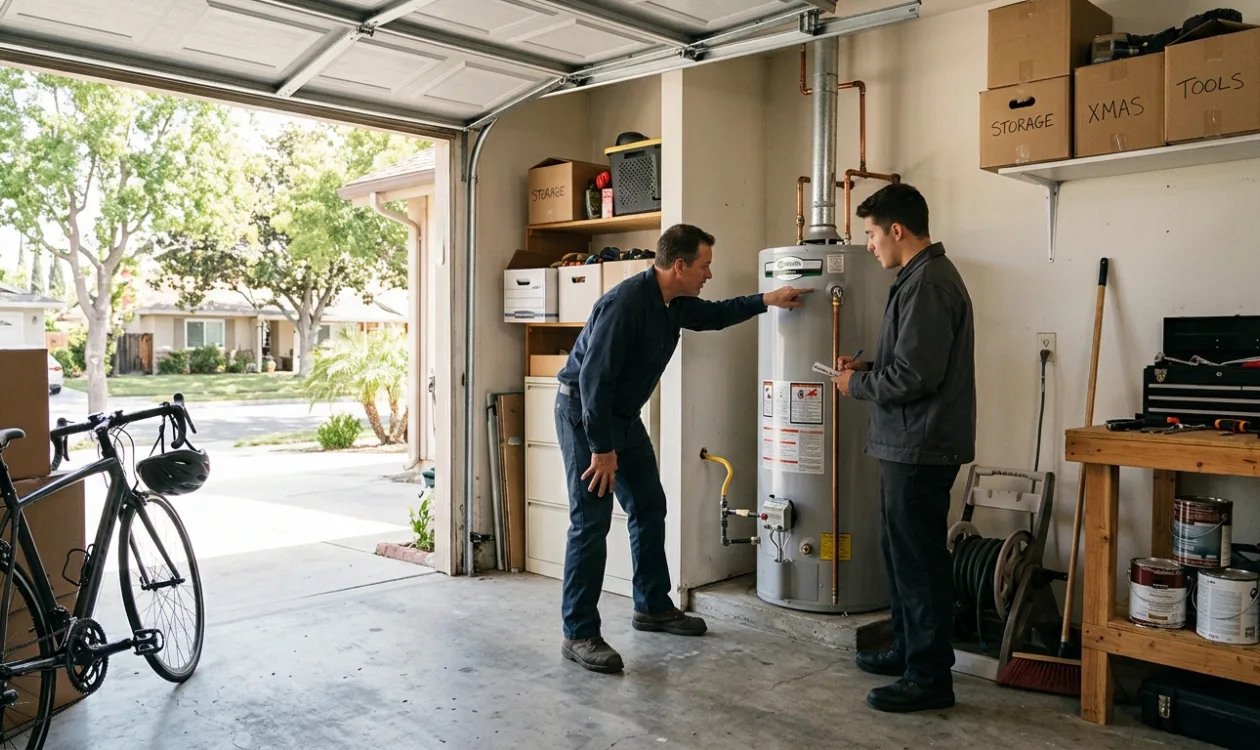
Pipe vintage in this city maps almost perfectly onto neighborhood age, which is why a plumber who works here can usually predict the material before arriving.
Near the older core around Historic Main Street, early-1900s craftsman cottages (including several long since converted to commercial use) commonly still carry galvanized supply. When one of those lets go, the useful conversation is rarely about the single joint. It is about whether to keep spending on individual repairs or replace the supply system in copper or PEX and be finished with it.
Across the vast 1950s and 60s ranch tracts that make up most of the city, including the larger-lot streets of West Garden Grove, the material is copper, and a good share of it runs under the slab. A burst under concrete behaves differently from one in a wall: there is no isolating valve, the water has nowhere visible to go, and the first symptom is often a warm floor or a meter that will not stop turning. That crosses over into slab leak territory, where the real decision is rerouting the line overhead versus opening the concrete.
In the newer condo and townhouse developments, supply runs are shared-wall and often stacked vertically between units, so a burst on an upper floor becomes a downstairs neighbor's ceiling. Access frequently requires the association's cooperation, and documentation of what was found matters as much as the repair itself.
One factor cuts across all of it: water pressure. A failed regulator at the front of the house can push 90 psi or more into a system designed for far less, and it does that quietly for years. It hammers washing machine valves, ice-maker lines and toilet fills, and it turns marginal copper into burst copper. Any burst pipe visit worth the money includes a gauge reading at a hose bib, because fixing the pipe and ignoring the pressure is how you end up making this same call again next year.
Burst pipe questions
The short version: stop the water, then worry about the wall.
Shut every fixture in the house off and watch the water meter. If the dial still moves, water is escaping from the supply system somewhere between the meter and the fixtures. A fixture leak stops when that fixture is closed; a burst line does not.
Both happen. A clean split from a nail or a single stressed fitting is a localized repair and the rest of the line is fine. Uniform thinning in copper, or corrosion through the threads of galvanized pipe, means the failure was a symptom rather than an event, and repairing one joint puts the pressure onto the next weakest one. Ask to see the section that came out; the pipe wall tells the story.
An accessible break (under a sink, in a garage, in a crawl space) is frequently a same-visit repair measured in a couple of hours. A break inside a finished wall or ceiling adds access and patching time, and a break under a slab is a different scope entirely. You will get a time estimate along with the price before work starts.
The plumber cuts the access needed and leaves the work area clean, but plumbing repair and finish carpentry are different trades. On larger openings most homeowners bring in a drywall or restoration contractor once the cavity is dry. The plumber can tell you how big the opening will be before cutting, which is worth asking.
Yes, and this is where people lose money. Sealing damp framing and insulation behind new drywall is how a plumbing repair becomes a mold remediation job months later. Air movement and time, or a professional dry-out for anything substantial, come before patching.
It can be a major contributor. Residential systems are happiest in the 50 to 75 psi range. When a pressure regulator fails open, pressure can sit well above that continuously, stressing every joint, valve and appliance connection in the house. A gauge on a hose bib takes thirty seconds and is worth doing at the same visit.
Not immediately, but it is usually the direction things head. Galvanized supply corrodes internally as well as at the joints, so even where it is not leaking it may be delivering poor pressure through a restricted bore. Many owners of older homes near the core repair the urgent failure now and plan a copper or PEX repipe as a separate, scheduled project rather than an emergency one.
Then the approach changes. There is no shut-off between a sub-slab line and the house, the leak is invisible, and access means either jackhammering a trench or abandoning that run and rerouting new pipe overhead through the attic and down interior walls. Rerouting is often faster, cleaner and cheaper than trenching, though a single failure near the perimeter can be worth opening directly.
That is part of a proper diagnosis. Moisture meters and thermal imaging show the wetted area rather than just the visible stain, which is what determines where drywall gets opened and what needs drying. Water in a wall routinely travels several feet horizontally before it appears.
Sometimes. If the failure is downstream of a branch valve, or on a fixture line with a working stop, the rest of the house can stay in service. In much of the older local housing stock those isolating valves either do not exist or are seized solid with scale, in which case the main comes off, and replacing that seized valve while everything is already shut down is usually a sensible add-on.
Cost drivers
A single accessible break and a line inside a finished wall are very different numbers.
Ask About Repair CostsRelated work
Acoustic, thermal and pressure testing to pin a leak before anything gets cut open.
Read moreWhen one joint failing means the rest of the system is on the same timeline.
Read moreA regulator stuck open at 90-plus psi is the quiet cause behind a lot of burst pipe calls.
Read moreWhere we do this work
Early-1900s craftsman stock with original galvanized supply.
Older cottages around the civic and farmers market blocks.
1960s ranch tracts, copper supply, much of it under slab.
Neighboring market of similar post-war tract housing.
Garden Grove & northwest Orange County
Standing water in a wall cavity turns into mold long before it turns into a claim.
Pipe Just Let Go?